Disclaimer: This article is for general educational purposes only and doesn't constitute financial advice. Loan terms, interest rates, and payoff timelines vary by lender and individual circumstances. Always review your loan agreement and consider speaking with a qualified financial advisor before making major changes to your repayment strategy.
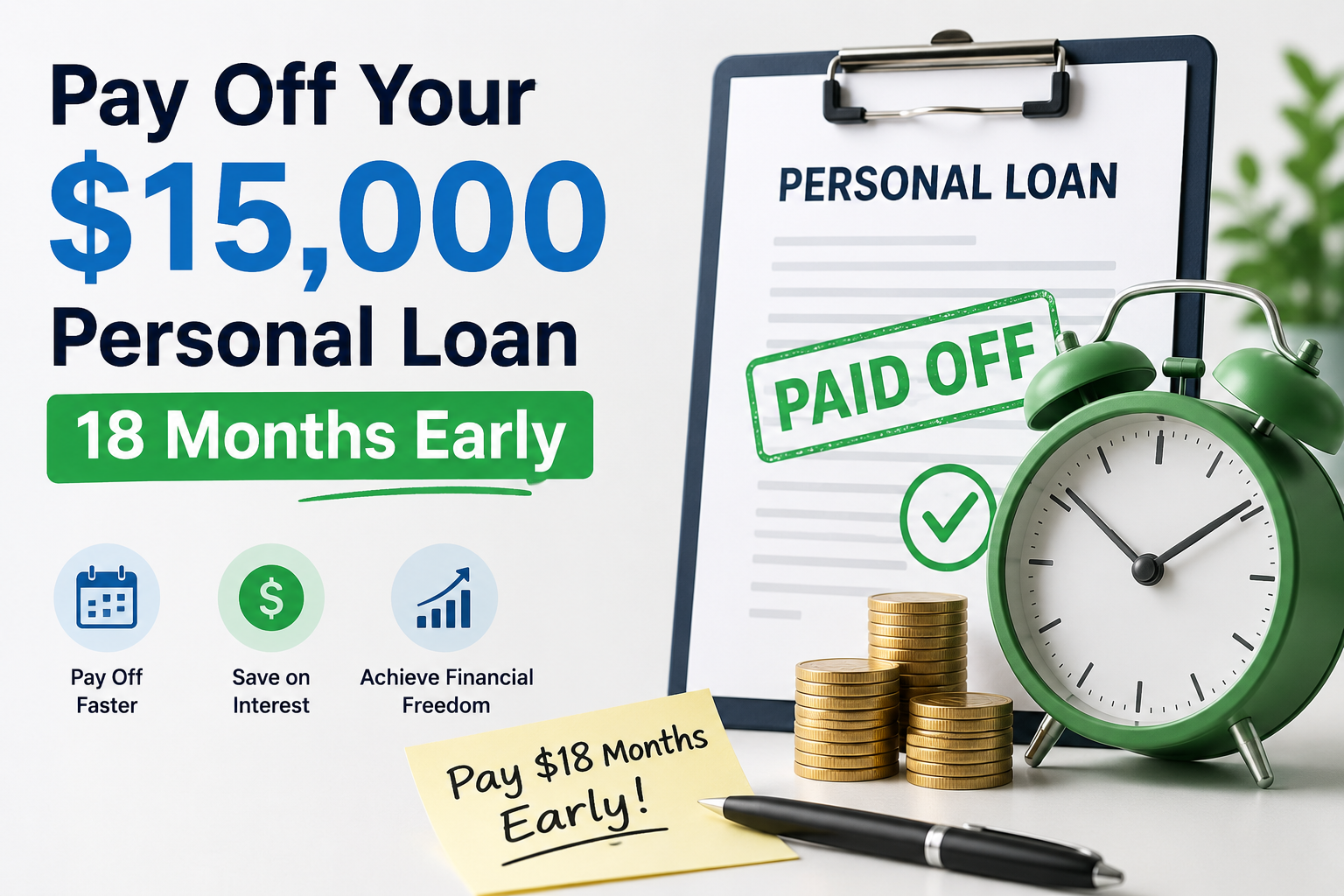
Staring down a $15,000 personal loan balance can feel like you're running on a treadmill that never stops. You make your payment every month, watch the interest chip away at your progress, and wonder if you'll ever actually cross the finish line.
Here's the encouraging part: with the right strategy, many borrowers can potentially shave a year or more off their loan term without winning the lottery or taking on a second job.
I've spent years helping people work through their budgets and untangle their debt, and I've seen firsthand how a handful of smart, repeatable habits can move a payoff date significantly closer. This isn't about deprivation. It's about making your money work a little harder than it currently does.
In this guide, I'll walk you through how personal loan payoff timelines actually work, the math behind extra payments, seven practical strategies you can start using this week, and the mistakes that quietly slow people down. Grab a coffee this one's worth reading start to finish.
Who This Guide Is For
This article is written for people who:
- Have an existing personal loan (roughly $10,000 - $20,000) and want to pay it off faster
- Can realistically free up an extra $50 -$250 a month, even if not every month
- Already have a small emergency cushion, or are close to building one
- Want a realistic, sustainable plan rather than an extreme, all-or-nothing approach
If you're currently missing payments or struggling to cover minimums, this guide isn't the right starting point. A nonprofit credit counselor or your lender's hardship program would serve you better first.
Why Paying Off a Personal Loan Early Actually Matters
Before we get into tactics, let's talk about why this is worth the effort. A lot of people assume debt is just debt you pay it off eventually, so why does the timeline matter?
Here's why it does, once you see the numbers.
Example scenario: Say you have a $15,000 personal loan at 11% APR with a 5-year (60-month) term. Your monthly payment would be roughly $326, and by the end of the loan, you'd pay approximately $4,560 in total interest.
Now imagine trimming that timeline to around 3.5 years instead of 5, by consistently paying extra toward principal. Depending on how much extra you add and when, you could potentially save $1,500-$2,000 in interest and free up your monthly cash flow more than a year ahead of schedule.
That's real money often the equivalent of a used car down payment or a solid emergency fund contribution.
The Emotional Weight of Debt Nobody Talks About
In my experience working through budgets with people, the financial savings are only half the story. Debt carries a psychological weight too.
It shows up as:
- That low hum of anxiety when a banking notification pops up
- The guilt that creeps in over small, unplanned purchases
- The mental math you do every time a bill is due
Paying off a personal loan ahead of schedule isn't just a numbers exercise it's peace of mind you can genuinely feel.
Understanding Your Loan Before You Attack It
You can't build an early payoff plan without knowing exactly what you're working with. This step gets skipped constantly, and it's often the reason payoff plans stall out.
Pull up your loan documents or log into your lender's portal and confirm:
- Interest rate (APR) - fixed or variable?
- Remaining term - how many months are left?
- Prepayment penalties - does your lender charge a fee for early payoff?
- Payment allocation rules - does extra money go to principal automatically, or do you need to specify it?
That last point trips up more people than you'd expect. I've seen borrowers send extra payments for months, assuming they were reducing their principal, only to later discover their lender was applying the overage toward future scheduled payments instead. Always confirm directly with your lender how extra payments are applied this one call can save you months of wasted effort.
A Quick Word on Prepayment Penalties
Most personal loans from banks and credit unions no longer carry prepayment penalties, but some online lenders and older loans still do. If yours does, it's worth running the numbers sometimes the interest saved still outweighs the penalty. Either way, it's better to know upfront than to be surprised later.
The Math Behind an Early Payoff (Realistic Numbers)
Let's get concrete. On a $15,000 loan at 11% APR over 60 months, here's roughly what tends to happen when you add consistent extra principal payments. These are illustrative estimates your actual results will depend on your specific rate, term, and payment timing.
- Extra $100/month → could pay off roughly 10-13 months early, saving an estimated $800 -$1,000 in interest
- Extra $175/month → could pay off roughly 16-19 months early, saving an estimated $1,400 -$1,700 in interest
- Extra $250/month → could pay off roughly 22-25 months early, saving an estimated $1,900 -$2,200 in interest
The pattern holds across most personal loans: consistent extra payments toward principal have an outsized effect over time, because you're shrinking the balance that future interest gets calculated on.
If you want numbers specific to your situation, running your exact loan details through a personal loan payoff calculator takes just a couple of minutes and it can completely change how you think about "extra" payments. Suddenly, they're not just extra. They're strategic.
7 Strategies to Pay Off Your Personal Loan Faster
Here's the actual playbook. You don't need all seven pick two or three that realistically fit your life and stack them together.
1. Round Up Every Payment
This sounds almost too simple, but it adds up. If your payment is $326, round it up to $350 or $400. That extra $24-$74 goes straight to principal every month, without requiring extra thought once it's set up.
2. Apply Windfalls Immediately
Tax refunds, work bonuses, birthday cash, cashback rewards instead of letting that money blend into your checking account and quietly disappear, send it directly to your loan the day it arrives.
I've personally seen this work best when it's automated. Clients who set up an instant transfer the moment a windfall lands stick with it far more consistently than those who plan to "do it later."
3. Use the Biweekly Payment Trick
Instead of one monthly payment, split it in half and pay every two weeks. Because there are 52 weeks in a year, this results in 26 half-payments the equivalent of 13 full monthly payments instead of 12.
That one extra payment a year quietly accelerates your payoff without feeling like a major sacrifice.
Quick note: confirm with your lender that biweekly payments are applied as received, not held and batched as one monthly payment. Servicing rules vary, so it's worth a quick call to check.
4. Cut One Recurring Subscription and Redirect It
You don't need to cancel every streaming service and stop eating out that kind of advice rarely sticks. Instead, pick one subscription or recurring cost you genuinely underuse. Maybe it's a gym membership you visit twice a month, or a subscription box you keep meaning to cancel.
Redirect that $15-$50 straight to your loan principal.
5. Try a No-Spend Month Quarterly
Once every three months, run a no-spend month where you cover only essentials rent, utilities, groceries, transportation. Everything else gets funneled toward your loan.
This isn't sustainable as a permanent lifestyle, but four focused months a year can meaningfully reduce your principal.
6. Refinance If Rates Have Dropped
If your credit score has improved since you took out the loan, or market rates have dropped, refinancing into a lower APR can reduce your total interest even without increasing your monthly payment.
One caution: make sure the new loan doesn't reset your term back to five years, unless you plan to keep voluntarily paying at your current, higher amount.
7. Automate an "Extra Principal" Transfer
Set up a separate automatic transfer even $50 that hits your loan account a few days after each paycheck. Automating it removes the willpower requirement entirely.
One thing I've consistently noticed while working with people on debt payoff: automated extra payments tend to succeed far more often than manual ones, simply because they don't depend on remembering or feeling motivated in any given week.
Real-Life Example: How Sarah Paid Off Her Loan Ahead of Schedule
A woman I worked with I'll call her Sarah had a $15,000 personal loan at 10.5% APR, with 58 months remaining on a 60-month term. She wasn't a high earner; she worked as a school administrator on a fairly fixed salary, supporting a household budget that left limited wiggle room.
Here's what she actually did, over roughly a year and a half:
- Rounded her $322 monthly payment up to $350, adding $28/month toward principal
- Canceled a $60/month meal-kit subscription she rarely used, redirecting that amount as well
- Applied a $1,100 tax refund directly to her loan balance in one lump sum
- Ran two deliberate no-spend months, putting an extra $300 -$400 toward principal each time
None of these moves were dramatic on their own. Combined and sustained consistently, they moved her payoff date up by roughly 17 months compared to her original schedule, and saved her an estimated $1,700 -$1,900 in interest.
Sarah later told me the biggest shift wasn't really about the math. It was realizing she had more control over her timeline than she'd assumed and that small, boring, repeatable actions added up faster than she expected.
(Individual results vary based on income, expenses, interest rate, and consistency. Sarah's numbers are illustrative of what's possible, not guaranteed.)
Common Mistakes That Slow Down Your Payoff
Not Specifying "Principal Only" on Extra Payments
If you send extra money without labeling it, some lenders apply it toward your next scheduled payment instead of reducing your balance. Always confirm by checking a box online or calling directly that extra funds go toward principal.
Ignoring Debt While Chasing Investment Returns
A common question: is it better to invest extra cash or pay down debt faster? There's no single right answer, but as a general guideline, if your loan's interest rate is above 7-8%, paying it down often makes strong financial sense, since it functions like a guaranteed "return" equal to your interest rate without market risk.
If you have access to an employer retirement match, though, it's usually worth contributing enough to capture that match first.
Letting Lifestyle Creep Absorb Extra Cash
A raise or bonus often quietly gets absorbed into slightly nicer everyday spending before you notice. Deciding in advance where windfalls will go helps remove that decision from an emotional, in-the-moment choice.
Forgetting to Track Progress
Not seeing your progress can quietly kill motivation. Whether it's a simple spreadsheet, a payoff app, or a printed debt tracker on your fridge, visual tracking helps sustain momentum on the months when motivation naturally dips.
Pros and Cons of Aggressive Early Payoff
Pros:
- Potential for meaningful interest savings over the life of the loan
- Improved debt-to-income ratio, which can help with future loan approvals
- Reduced financial stress and more predictable monthly cash flow
- Freed-up money sooner for savings, investing, or other goals
Cons:
- Less available monthly cash flow while paying aggressively
- Potential opportunity cost if you don't yet have an emergency fund
- Possible prepayment penalties on certain loans, which could offset some savings
If you don't already have at least a small emergency cushion even $500-$1,000 it's generally worth building that first. Paying off debt aggressively with zero safety net often means one unexpected expense (a car repair, a medical bill) sends you right back into debt.
How to Build Your Own Early Payoff Plan
Here's a simple framework to get started this week:
- Confirm your current numbers - balance, rate, remaining term, and prepayment rules.
- Pick two or three strategies from the list above that realistically fit your life.
- Estimate your new payoff date using a loan calculator with your extra payment amount.
- Automate what you can - extra transfers, rounded-up payments, windfall redirects.
- Check in monthly to confirm extra payments are actually reducing principal.
- Acknowledge milestones - every $1,000 paid down ahead of schedule is worth recognizing.
Final Thoughts: Your Timeline Is More Flexible Than You Think
Paying off a $15,000 personal loan well ahead of schedule isn't reserved for high earners or people with unusually large budgets. For many borrowers, it comes down to a series of small, repeatable decisions that compound over time a rounded-up payment here, a redirected subscription there, a windfall applied at the right moment.
None of it requires perfection. It requires consistency, and a plan that actually fits your real life.
Start with one strategy this month. Not five just one. Once it feels automatic, layer in another. Over time, you may find yourself checking your loan balance and realizing you're months, maybe longer, ahead of where the original schedule said you'd be.
Paying down debt faster than expected is one of those quiet wins that changes how you feel about money not overnight, but steadily. That shift is worth working toward.
This article is intended for general informational purposes and shouldn't be treated as personalized financial advice. Everyone's financial situation is different consider consulting a licensed financial advisor or credit counselor before making significant changes to your loan repayment strategy.
Frequently Asked Questions
1. Will paying off my personal loan early hurt my credit score?
It can cause a small, temporary dip, since it closes an active installment
account and slightly changes your credit mix. For most people, the longer-term
benefit of lower debt and an improved debt-to-income ratio outweighs this
minor, short-lived effect.
2. Do all personal loans allow extra payments toward principal?
Most do, but not all apply extra payments the same way. Always confirm with
your lender whether extra funds reduce principal immediately or get held toward
your next scheduled payment.
3. Is it better to pay off a personal loan or save for retirement
first?
It depends on your interest rate and whether an employer match is available. If
your loan's rate is high (above 7-8%) and there's no match on the table,
prioritizing the loan often makes sense. If a match is available, it's usually
worth contributing enough to get it first.
4. How much extra do I need to pay to significantly shorten my loan
term?
It varies by rate and remaining term, but on a typical $15,000 loan around 10-11%
APR, an extra $150-$200 a month toward principal often results in meaningfully
faster payoff commonly in the 12-20 month range, depending on consistency.
5. What's the fastest way to find extra money for loan payments?
Start with windfalls (tax refunds, bonuses), one canceled subscription, and
rounding up your regular payment. These three combined rarely require major
lifestyle changes.
6. Are there penalties for paying off a personal loan early?
Some lenders charge prepayment penalties, though this has become less common.
Check your loan agreement or contact your lender directly before making large
extra payments.
7. Should I refinance my personal loan to pay it off faster?
Refinancing can make sense if you can secure a meaningfully lower interest
rate, especially if your credit score has improved since you took out the loan.
Just be cautious about resetting to a longer term unless you plan to keep
paying at your original, higher amount.