The Introduction You Didn't Know You Needed
Let me ask you something. Have you ever sat down, punched numbers into a savings calculator, felt genuinely excited about the result and then realized a few years later that your money doesn't feel as "big" as the calculator promised?
Yeah. Most people have been there.
The problem isn't compound interest. Compound interest is, without exaggeration, one of the most powerful wealth-building forces in the world. The problem is that most calculators oversimplify things. They assume you'll contribute the same fixed amount every single month forever, and they completely ignore inflation the silent tax that erodes your purchasing power year after year.
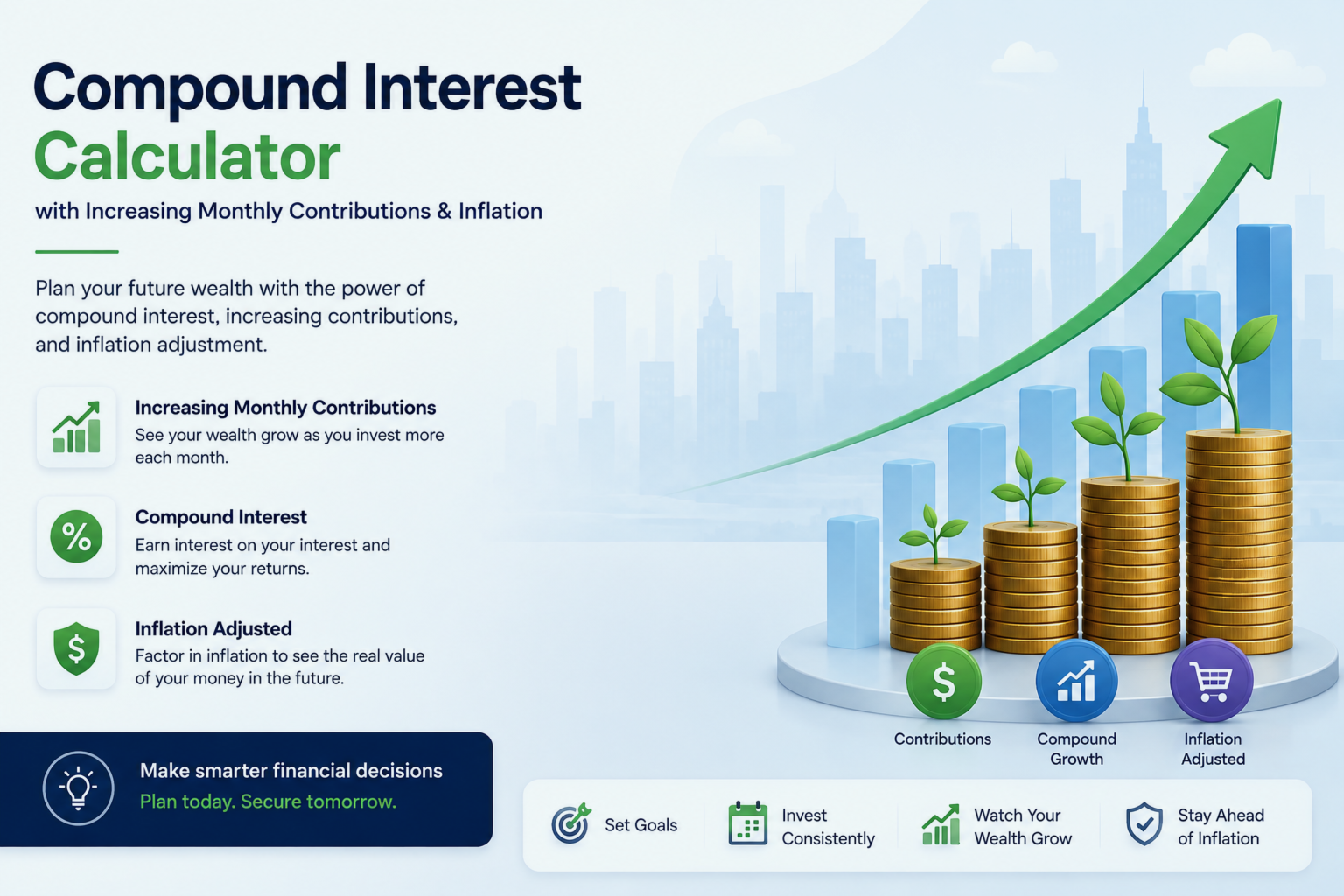
In this article, I'm going to break down exactly how a compound interest calculator with increasing monthly contributions and inflation gives you a far more realistic and far more useful picture of your financial future. We'll cover the math (in plain English, I promise), walk through real examples, and talk about the mistakes people make when they rely on overly simplified tools. By the end, you'll know exactly how to plan smarter.
What Is Compound Interest (And Why Should You Actually Care)?
Most people learn about compound interest in school, forget it by graduation, and rediscover it in their 30s while panicking about retirement. So let's do a quick, painless refresher.
Compound interest is interest calculated on both the initial principal and the interest that has already been added to that principal. In other words, your interest earns interest. Over time, this creates an exponential growth curve rather than a straight line and that difference is massive.
The Classic Example That Actually Makes Sense
Imagine you invest $5,000 at an annual interest rate of 7%, compounded monthly. After one year, you don't just earn $350. You earn slightly more because interest is being added each month and then that interest starts compounding too. It doesn't sound like a huge deal at first. But stretch that out to 30 years? The numbers become almost unbelievable.
Now here's what most basic calculators miss: they assume your monthly contribution stays exactly the same from year one to year thirty. But honestly, when's the last time your income stayed exactly the same for three decades? Life doesn't work like that. You get raises. You grow your business. You cut expenses. Your contributions naturally change and usually, they increase.
That's where a compound interest calculator with increasing monthly contributions becomes a game-changer.
Why Increasing Monthly Contributions Change Everything
Here's something I've noticed after years of helping people understand their finances: the single most underestimated factor in long-term wealth building isn't the interest rate. It's contribution growth.
Think about it this way. If you're earning a 3-5% raise every year, it's reasonable to assume you can also increase your monthly investment by even 2-3% annually. Sounds small, right? Let's see what actually happens.
Say you start contributing $200 per month. With a static calculator, that stays $200 forever. But with an increasing monthly contribution model let's say contributions grow by 3% per year by year 10 you're contributing about $269 per month, and by year 20 you're up to around $361 per month. Those extra dollars, compounded over decades, can add tens of thousands sometimes hundreds of thousands to your final balance.
Why This Matters for Real Financial Planning
Static contribution models are fine for a rough sketch. But if you're making actual financial decisions deciding how much house to buy, whether to start a business, when you can retire you need numbers that reflect reality. And reality includes the fact that most disciplined investors increase their contributions over time as their income grows.
A variable contribution compound interest model captures this natural progression. It's not pessimistic or overly optimistic. It's just more honest.
The Inflation Problem Nobody Talks About Enough
Now here's where things get a little uncomfortable. And I mean that in the best possible way.
Let's say your compound interest calculator tells you that in 25 years, you'll have $400,000. That sounds fantastic. But here's the question nobody asks: what will $400,000 actually buy in 25 years?
With an average annual inflation rate of around 3%, the purchasing power of money roughly halves every 23-24 years. So that $400,000 in nominal terms might only feel like $200,000 in today's money. That's a massive difference when you're planning your retirement lifestyle.
Real Returns vs. Nominal Returns
This is where the distinction between nominal returns and real (inflation-adjusted) returns becomes critical.
- Nominal return: The stated interest rate before accounting for inflation
- Real return: Your actual gain in purchasing power after inflation is factored in
The rough formula? Real return ≈ Nominal interest rate − Inflation rate
If you're earning 7% annually on your investments but inflation is running at 3%, your real return is closer to 4%. That's still great but it's not 7%. And over 30 years, planning with 7% instead of 4% can leave you financially short in ways that genuinely hurt.
An inflation-adjusted compound interest calculator shows you both figures what your money will be worth in nominal terms and what it'll actually buy in real terms. That dual view is incredibly valuable.
How a Compound Interest Calculator with Inflation Works
A standard compound interest formula looks like this:
Total Amount = P × (1 + (R ÷ 100) ÷ N) ^ (N × T)
Where:
- P = Principal (your starting investment amount)
- R = Rate your annual interest rate as a percentage (e.g., 7 for 7%)
- N = Number of times interest compounds per year (e.g., 12 for monthly)
- T = Time in years
So for example, if you invest $5,000 (P) at 7% annual interest (R), compounded monthly (N = 12), over 10 years (T), the formula works out like this:
Total = 5000 × (1 + (7 ÷ 100) ÷ 12) ^ (12 × 10)
Simple enough. But when you add increasing monthly contributions and inflation into the mix, the formula gets layered. Each month's contribution is slightly larger than the last, and once you calculate your final nominal balance using the formula above, you then deflate it by the cumulative inflation rate to get the real value what your money is actually worth in today's purchasing power.
Most people aren't going to do this math by hand and they shouldn't have to. That's exactly why using a dedicated tool makes so much sense. If you want to see this in action with your own numbers, you can try this compound interest calculator that accounts for different contribution levels and gives you a much clearer picture of your long-term wealth.
Key Variables You'll Need
- Initial investment (principal)
- Monthly contribution amount
- Annual contribution increase rate (e.g., 3%)
- Annual interest rate
- Compounding frequency (monthly, quarterly, annually)
- Investment time horizon (years)
- Expected annual inflation rate
Having all of these inputs gives you a genuinely useful projection rather than an overly optimistic fantasy.
Step-by-Step: Using the Calculator Correctly
Here's how to get the most out of a compound interest calculator with increasing monthly contributions and inflation adjustment:
Step
1: Enter your starting amount.
This is whatever you're investing today. Don't inflate this number be honest.
Step
2: Set your initial monthly contribution.
Again, be realistic. What can you actually commit to right now?
Step
3: Set your annual contribution increase rate.
A conservative estimate is 2-3% per year, roughly in line with modest income
growth. If you're more aggressive about saving, you might push this to 5%.
Step
4: Enter your expected annual return.
For stock market investments, historical long-term averages have hovered around
7-10% annually (nominal). For conservative portfolios, maybe 4-5%.
Step
5: Set the inflation rate.
Historically, inflation has averaged around 2-3% annually in most developed
economies. Use 3% for a safe estimate.
Step
6: Choose your time horizon.
The longer, the better when it comes to compounding. Even adding five more
years can dramatically change your outcome.
Step
7: Review both nominal and real (inflation-adjusted) results.
Always look at both. The nominal number tells you the dollar amount. The real
number tells you what it's actually worth.
Real-Life Case Study: Two Friends, Two Completely Different Outcomes
Let me tell you about two hypothetical people Maya and Sara who start investing at the same age with the same initial conditions but use different planning approaches.
Both are 30 years old. Both start with $1,000 and contribute $300 per month. Both earn a 7% annual return over 30 years.
Maya uses a basic compound interest calculator. It tells her she'll have roughly $363,000 at age 60. She's happy with that.
Sara uses an inflation-adjusted calculator with increasing monthly contributions. She sets a 3% annual contribution increase and a 3% inflation rate. Her calculator shows:
- Nominal balance at 60: approximately $512,000 (higher because her contributions grew over time)
- Inflation-adjusted real balance: approximately $217,000 in today's purchasing power
Sara's planning completely changes as a result. She realizes she needs to either invest more, adjust her lifestyle expectations, or plan to work a few extra years. She makes those adjustments at 30 when she still has time to course-correct.
Maya finds out at 58. That's a very different situation.
The tool didn't make Sara's outcome worse. It just gave her the truth early enough to do something about it.
Common Mistakes People Make When Calculating Compound Interest
In my experience, these are the errors that trip people up most often:
- Using a fixed monthly contribution when income is growing. If you're getting raises and not increasing contributions, you're leaving money on the table.
- Ignoring compounding frequency. Monthly compounding grows faster than annual compounding, even at the same stated rate. Always check this setting.
- Forgetting inflation entirely. This is the big one. Nominal numbers feel exciting. Real numbers are what matter.
- Assuming a constant interest rate. Markets fluctuate. A single fixed rate is an approximation, not a guarantee. Build in some buffer.
- Starting with an unrealistically high contribution. If you can't actually sustain the contribution you enter, your projections are fiction. Be honest with yourself.
Practical Tips to Maximize Your Returns with Increasing Monthly Contributions
Knowing the math is great. But applying it is where the real magic happens. Here are some tips that actually work:
Automate your annual contribution increases. Set a calendar reminder every January to bump your monthly investment by at least 2%. Most people forget to do this manually.
Use windfalls strategically. Tax refunds, bonuses, side income even a one-time extra contribution of $500-$1,000 can have a significant long-term impact when compounded over decades.
Match your contribution growth to your income growth. A good rule of thumb: when your income increases by X%, direct at least 25-50% of that increase toward savings and investments.
Revisit your projections annually. Inflation rates change. Interest rates change. Your life changes. Recalculating once a year keeps your financial plan grounded in current reality.
Start earlier, not bigger. Time is the single most powerful variable in compound interest. Starting at 25 with $100/month often beats starting at 35 with $300/month. The math doesn't lie.
Conclusion: The Numbers Don't Lie But Basic Calculators Often Do
Here's the bottom line. Compound interest is genuinely extraordinary. But only when you understand what your numbers actually mean in the real world.
A basic calculator gives you a starting point. A compound interest calculator with increasing monthly contributions and inflation gives you a roadmap. There's a meaningful difference between those two things when you're making decisions that will shape the next 20-30 years of your life.
The key takeaways from everything we've covered:
- Increasing contributions over time significantly boosts your final balance
- Inflation-adjusted returns show you what your money will actually be worth
- Real financial planning requires both nominal and real figures
- Small, consistent increases in contributions compound dramatically over decades
- Use a reliable, comprehensive calculator and revisit your projections every year
Don't settle for oversimplified tools when your financial future deserves better. Run the real numbers, factor in inflation, build in contribution growth, and make decisions with a clear, honest picture in front of you.
FAQ
1.
What is a compound interest calculator with increasing monthly contributions?
It's a financial tool that calculates your investment growth over time while
accounting for contributions that grow incrementally usually annually rather
than staying fixed. This gives a more realistic projection of long-term wealth
accumulation.
2.
Why should I include inflation in my compound interest calculations?
Because inflation erodes purchasing power over time. A nominal balance of
$500,000 in 30 years won't buy what $500,000 buys today. Inflation-adjusted
calculations show you what your money is actually worth in real terms, helping
you plan more accurately.
3.
What annual contribution increase rate should I use?
A conservative and realistic range is 2-4% per year, roughly matching modest
income growth or cost-of-living increases. If you're expecting strong career
progression, you might use 5-7%.
4.
How does compounding frequency affect my returns?
More frequent compounding means slightly higher returns. Monthly compounding
produces more growth than quarterly or annual compounding at the same interest
rate. It's a smaller difference than most people expect, but it adds up
meaningfully over decades.
5.
What inflation rate should I plug into the calculator?
Historically, a rate between 2-3% per year is a reasonable long-term estimate
for most major economies. Using 3% gives you a slightly more conservative (and
therefore safer) projection.
6.
Is it better to increase monthly contributions or make lump-sum investments?
Both strategies have merit. Increasing monthly contributions builds discipline
and takes advantage of dollar-cost averaging. Lump-sum investments, when timed
well, maximize time in the market. Ideally, you do both: grow your regular
contributions and invest windfalls when they arise.
7.
At what age should I start factoring inflation into my financial planning?
Honestly? As soon as you start investing. Inflation's effect compounds just
like interest does and the earlier you account for it, the more accurately you
can plan your retirement, emergency fund, and long-term financial goals.
Disclaimer
The information provided in this article is intended for educational and informational purposes only. It should not be considered professional financial, investment, or legal advice. While every effort has been made to ensure the accuracy and reliability of the content, financial markets, interest rates, and inflation figures are subject to change and may vary based on individual circumstances and geographic location.
The examples, case studies, and calculations mentioned throughout this article are for illustrative purposes only and do not guarantee any specific financial outcome. Always consult a certified financial advisor or professional before making any investment decisions. The author and publisher are not responsible for any financial losses or decisions made based on the information shared in this article.