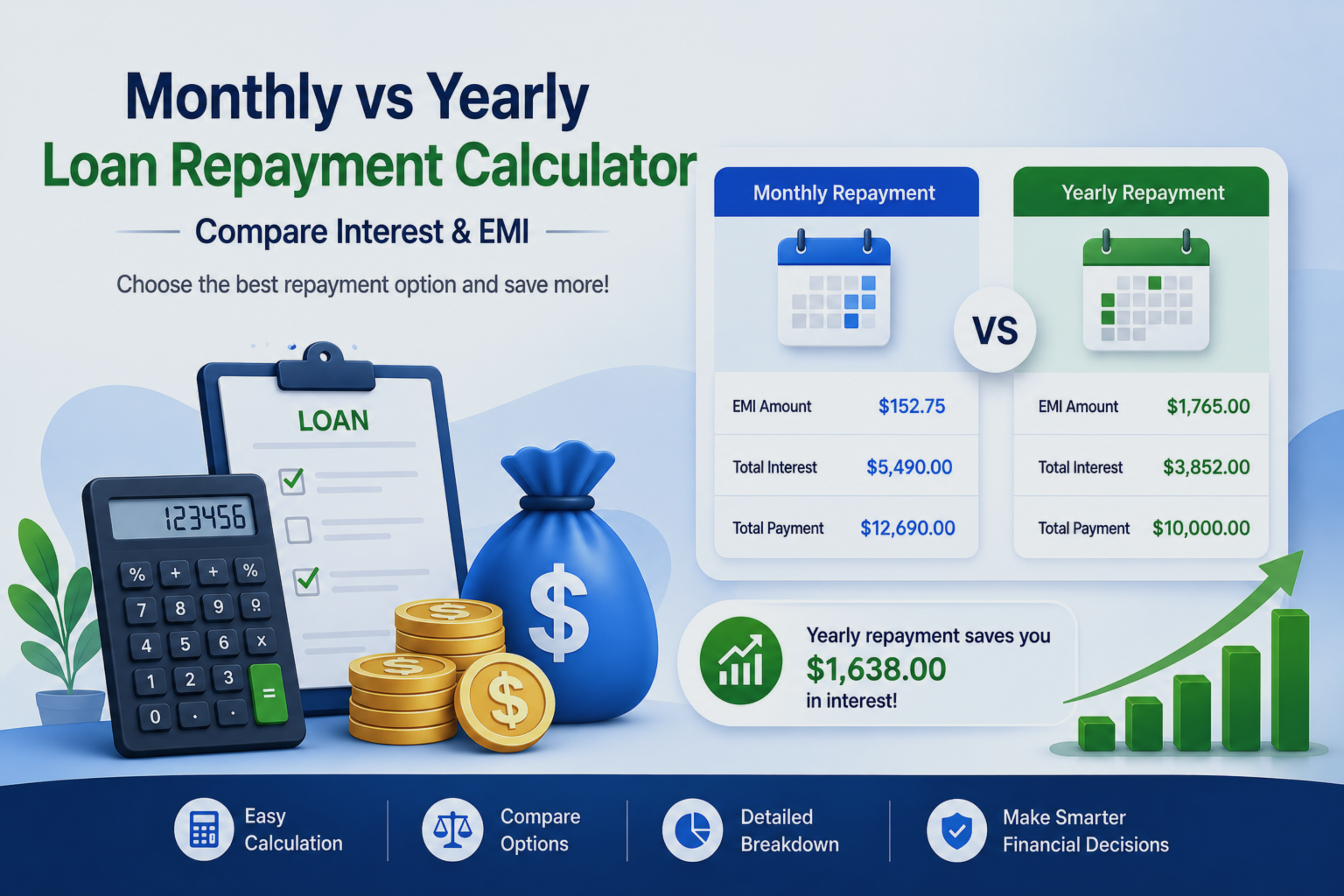
Choosing between a monthly and yearly view of your loan repayment isn't just a matter of preference it directly affects how well you understand what a loan costs. A monthly EMI calculator tells you what leaves your account each month. A yearly loan repayment calculator shows how much of your money goes toward interest versus principal, and how that balance shifts over time. Understanding both is the difference between picking a loan that "fits your budget" and picking one that's cost-effective.
This guide breaks down how each calculator works, walks through precise EMI and interest calculations using a real loan example, and shows how to use both tools together to make a smarter borrowing decision.
What Is a Loan Repayment Calculator?
A loan repayment calculator uses three core inputs principal (P), annual interest rate (R), and loan tenure (T) to calculate how much you'll repay over the life of a loan. The output can be shown two ways: as a fixed monthly installment, or as a yearly breakdown showing cumulative interest and principal paid.
The math behind both views is identical. What differs is how the results are presented, and that matters more than most borrowers realize. A monthly figure feels small and manageable. A yearly or total figure reveals the true cost of borrowing, which is often far higher than the monthly number suggests.
Lenders tend to advertise the monthly EMI prominently because it's the more attractive figure. Total interest cost the number that determines whether a loan is a good deal is usually left for borrowers to work out themselves. That's why knowing how to calculate both is valuable.
Monthly EMI Calculator: The Formula Explained
The standard EMI formula is:
EMI = [P × r × (1 + r)^n] ÷ [(1 + r)^n − 1]
Where:
- P = Principal loan amount
- r = Monthly interest rate (annual rate ÷ 12 ÷ 100)
- n = Total number of monthly installments (tenure in years × 12)
If you prefer working directly with the annual rate and tenure in years, the same formula can be written as:
EMI = [P × (R ÷ 1200) × (1 + R ÷ 1200)^(T × 12)] ÷ [(1 + R ÷ 1200)^(T × 12) − 1]
Here, R is the annual interest rate as a percentage, and T is the tenure in years. Dividing R by 1200 converts the annual percentage rate into a monthly decimal rate. Multiplying T by 12 converts the tenure into the number of monthly payments.
Working Through the Numbers
Take a $20,000 loan at 9% annual interest over 5 years:
- Monthly rate: 9 ÷ 1200 = 0.0075
- Number of installments: 5 × 12 = 60
Plugging these into the formula gives an EMI of $415.17 per month. Over 60 months, that totals $24,910.20, meaning $4,910.20 goes toward interest over the life of the loan.
This is what a monthly calculator is good for: it converts a large, abstract loan amount into a concrete number you can measure against your monthly income and expenses.
What a Monthly Calculator Is Best For
- Budgeting monthly cash flow with accuracy
- Comparing affordability across different loan amounts or lenders
- Testing how a longer or shorter tenure changes your monthly commitment
- Deciding between competing loan offers based on what fits comfortably into your income
It's usually the first calculation borrowers run and that's reasonable. Just don't let it be the last one.
Yearly Loan Repayment Calculator: Understanding Amortization
A yearly repayment calculator groups your monthly payments into annual totals and separates them into interest paid and principal paid for that year. This is where loan amortization becomes visible.
In the early years of most loans, a disproportionately large share of each payment goes toward interest rather than reducing the principal. As the loan matures, that ratio flips more of each payment starts chipping away at the balance. A monthly view hides this shift almost entirely, since each individual payment looks the same. A yearly view makes it obvious.
A Quick Example: Year One of the 5-Year Loan
Take the same $20,000 loan at 9% for 5 years, with a monthly EMI of $415.17. Over the first 12 payments:
- Total paid in Year 1: $4,982.04
- Interest paid in Year 1: approximately $1,665.37
- Principal paid in Year 1: approximately $3,316.67
So in the first year alone, roughly a third of every payment goes toward interest. By the final year of the loan, that ratio nearly reverses, with most of each payment reducing the principal. A monthly EMI calculator won't show you this shift a yearly one will.
Why the Yearly Breakdown Matters
- It shows the interest-to-principal shift. You can see which years are interest-heavy and which are principal-heavy essential if you're considering paying off the loan early.
- It simplifies tax and accounting needs. If you're claiming mortgage interest or business loan interest as a deduction, you need annual totals, not scattered monthly fragments.
- It supports better long-term decisions. Seeing that you'll pay $1,665 in interest this year alone tends to prompt more decisive action refinancing, increasing payments, shortening tenure than a quiet $415 monthly debit ever will.
Comparing loan structures side by side, using both monthly EMI and yearly amortization data, consistently gives a clearer picture of total borrowing cost than either view alone.
Monthly vs Yearly: Key Differences That Actually Matter
1. Purpose
- Monthly calculator: Determines short-term affordability and cash flow impact.
- Yearly calculator: Reveals long-term cost and how quickly your debt is decreasing.
2. Interest Visibility
Interest costs are easy to overlook in a monthly view because each payment feels small and routine. A yearly breakdown makes the total interest burden explicit and harder to ignore.
3. Use in Decision-Making
Monthly figures answer: "Can I afford this?"
Yearly figures answer: "Is this the better deal?"
Both questions matter, but they're not the same question, and relying on only one can lead to a costly decision.
4. Behavioral Impact
Numbers influence decisions more than most borrowers expect. A small monthly figure often leads people to underestimate total debt, while an annual total tends to prompt more proactive repayment behavior making extra payments, choosing a shorter tenure. Financial advisors often recommend reviewing the yearly amortization schedule specifically because it tends to motivate faster repayment.
Real-Life Example: $20,000 Loan Compared Two Ways
To see the difference clearly, compare two repayment options for the same $20,000 loan at the same 9% interest rate.
Option A - 5-Year Tenure (60 months)
- Monthly EMI: $415.17
- Total repayment: $24,910.20
- Total interest paid: $4,910.20
Option B - 3-Year Tenure (36 months)
- Monthly EMI: $635.99
- Total repayment: $22,895.64
- Total interest paid: $2,895.64
What This Comparison Reveals
Looking only at the monthly EMI, Option A appears more affordable over $220 less per month. Many borrowers would stop there and choose the longer tenure without a second thought.
But the yearly and total-cost view tells a different story. Option B costs $220.82 more per month, yet saves $2,014.56 in total interest over the life of the loan. That's the practical value of running both calculations: the monthly figure protects your budget, while the yearly figure protects your wallet over time.
The right choice depends on your financial situation. If the higher monthly payment is manageable without straining your budget, Option B is the more cost-effective path. If cash flow is tight, Option A provides breathing room at a quantifiable cost of just over $2,000.
Which Calculator Should You Use - And When?
The most reliable approach is to use both calculators, but at different stages of your decision.
Step 1: Check Affordability With a Monthly Calculator
Before anything else, confirm the monthly EMI fits comfortably within your budget ideally without exceeding 30-40% of your take-home income when combined with other debt obligations.
Step 2: Confirm True Cost With a Yearly Calculator
Once you know a loan is affordable, calculate the yearly or total interest cost. This step separates a loan that merely fits your budget from one that's a good deal.
Step 3: Compare Across Tenure Options
Run both calculations across two or three tenure options (for example, 3, 5, and 7 years) for the same loan amount and rate. This quickly shows the trade-off between monthly affordability and total interest cost, letting you choose based on priorities rather than guesswork.
When Each Calculator Takes Priority
- Prioritize monthly figures when your main concern is day-to-day cash flow, such as when managing multiple existing debts.
- Prioritize yearly figures when comparing competing loan offers, deciding whether to refinance, or planning for tax deductions tied to annual interest paid.
Common Mistakes to Avoid With EMI Calculators
1. Ignoring the Full Amortization Schedule
Most calculators can generate a complete year-by-year or month-by-month breakdown. Skipping this means missing how your interest and principal split evolves information that's essential if you're planning to pay off the loan ahead of schedule.
2. Overlooking Prepayment Penalties
Some lenders charge a fee for early repayment. If reducing total interest through extra payments is part of your strategy, confirm there's no prepayment penalty before committing.
3. Comparing Loans With Different Tenures Using Only EMI
A lower monthly EMI does not automatically mean a cheaper loan. As shown above, a shorter tenure with a higher EMI can save thousands in total interest. Always compare total or yearly cost, not just the monthly figure.
4. Not Recalculating for Variable Rates
If your loan carries a floating interest rate, both your EMI and total interest cost can shift when rates change. Recalculate periodically rather than relying on a single initial estimate.
5. Forgetting Fees and Add-Ons
Processing fees, insurance premiums, and administrative charges are often excluded from basic EMI calculations. Always request a full cost breakdown from the lender, not just the interest-based EMI.
Practical Tips for Smarter Loan Repayment
- Calculate both the minimum-payment scenario and an extra-payment scenario. Even modest additional payments can meaningfully reduce total interest over time.
- Save the full amortization schedule, not just the summary figures. It's easier to track progress against a detailed schedule than to reconstruct it later from memory.
- Round up your EMI when possible. An extra $20–$50 per month, applied consistently, can shorten a long-term loan by months or even years.
- Reassess annually. Interest rate changes, income increases, or new financial goals can all justify recalculating your repayment strategy.
- Avoid choosing the lowest monthly payment by default. It's often the most expensive option long term, even though it looks the most affordable upfront.
Conclusion: Use Both Views Before You Commit
A monthly loan repayment calculator and a yearly loan repayment calculator serve two different but equally important purposes. The monthly view keeps your budget realistic and manageable. The yearly view keeps your total borrowing cost transparent and honest. Relying on just one gives you an incomplete picture and that gap is exactly where borrowers end up overpaying without realizing it.
Before signing any loan agreement, calculate both figures. Confirm the monthly EMI fits your budget, then check the total or yearly interest cost to understand what the loan will cost over its full term. This simple two-step habit takes only a few minutes but can save thousands of dollars over the life of a loan.
If you're currently comparing loan offers, run your numbers through both calculations side by side before making a final decision. It's a small step with a significant payoff.
Frequently Asked Questions
1. What's the difference between a monthly and yearly loan repayment
calculator?
A monthly calculator shows the fixed installment due each month, while a yearly
calculator totals those payments annually and breaks them down into interest
paid versus principal paid for that specific year.
2. Which calculator shows the true cost of a loan more accurately?
The yearly or total-tenure calculator gives a clearer picture of total cost,
since it reveals cumulative interest paid over time rather than a single
month's snapshot.
3. Can a lower monthly EMI still result in paying more overall?
Yes. A longer tenure typically lowers the monthly EMI but increases total
interest paid over the life of the loan. Always cross-check the total or yearly
interest figure before assuming a lower EMI is the better deal.
4. How do I calculate EMI manually without an online tool?
Use the formula EMI = [P × r × (1 + r)^n] ÷ [(1 + r)^n − 1], where P is the
principal, r is the monthly interest rate (annual rate ÷ 12 ÷ 100), and n is
the total number of monthly payments (tenure in years × 12).
5. Do these calculators account for prepayments or extra monthly
payments?
Standard calculators typically assume fixed, regular payments. To see the
impact of prepayments, look for a calculator with a dedicated extra-payment
feature, or manually reduce the principal and recalculate the remaining
schedule.
6. Is a monthly EMI calculator still accurate for loans with
variable interest rates?
It provides an accurate estimate based on the current rate, but the actual EMI
will change if the rate adjusts. For floating-rate loans, recalculating
periodically is essential.
7. How often should I review my loan repayment numbers?
At minimum, once a year or immediately after any interest rate change, income
change, or before considering extra payments or refinancing.