Disclaimer: This article is for informational purposes only and does not constitute financial, banking, or investment advice. Interest rates, policies, and results vary significantly by bank and individual situation. Always verify current rates and terms directly with your financial institution before making any decisions.
Many people assume that the only way to earn more interest on their savings is to open a new account somewhere else. While switching banks is certainly one option, it is not always necessary and for many people, it is not even the most convenient choice.
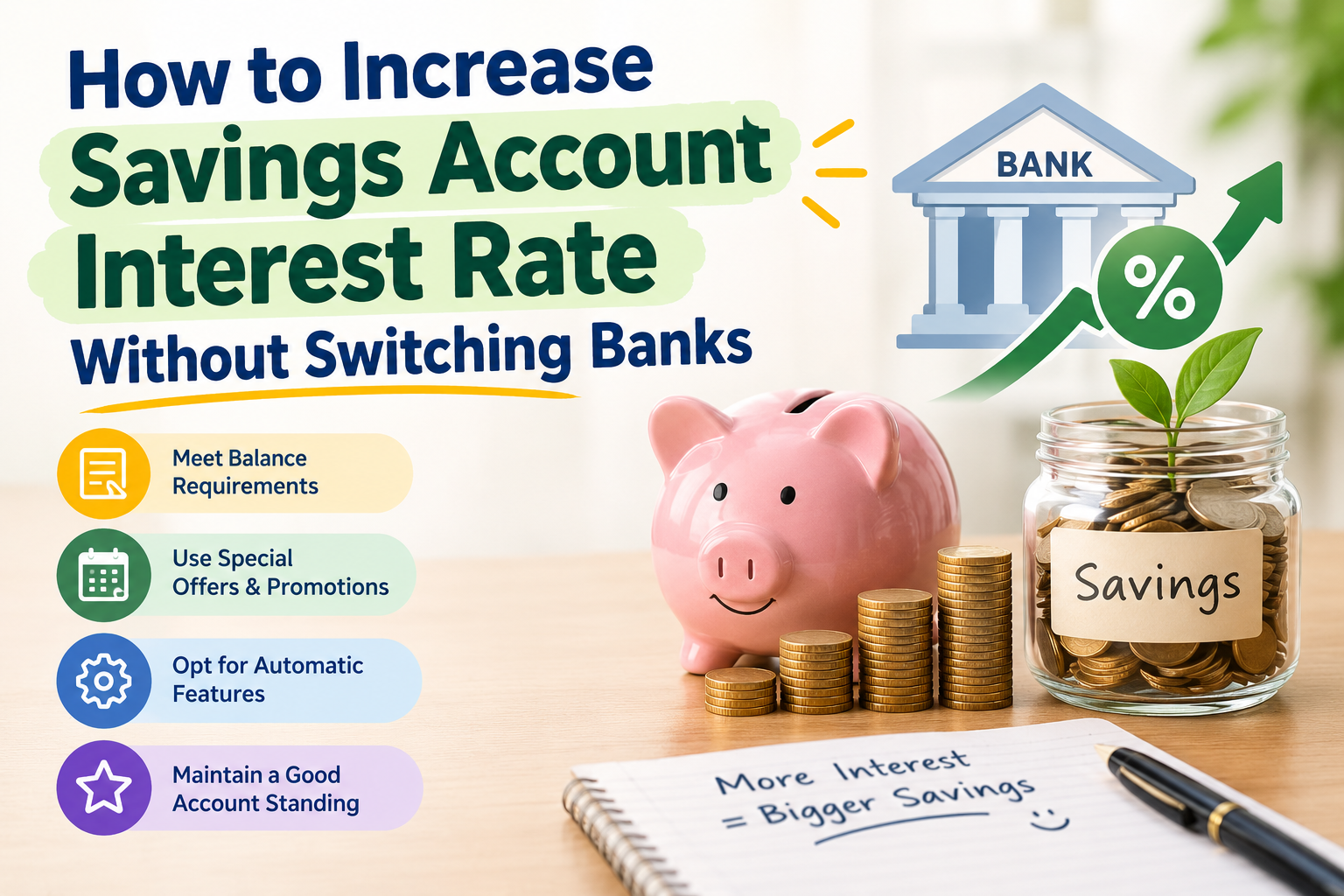
There are several practical strategies that can help you earn more from your existing savings account without the hassle of transferring your money to a new institution. These approaches range from simple conversations with your bank to adjusting how your accounts are structured.
This guide covers those strategies in a clear, step-by-step format. Some methods will work better for certain types of banks and account holders than others. Managing expectations here matters not every strategy will produce results in every situation, but understanding your options allows you to make more informed decisions about where your money works hardest.
Table of Contents
- Why Your Savings Rate May Not Be Working as Hard as It Could
- Is Negotiating a Higher Savings Interest Rate Actually Possible?
- How to Prepare Before You Contact Your Bank
- Strategies to Potentially Increase Your Savings Account Interest Rate
- Leverage CDs to Earn More Within Your Existing Bank
- Money Market Accounts - A Useful Alternative to Consider
- Understanding Tiered Interest Rate Structures
- A Sample Script for Talking to Your Bank
- If Your Bank Cannot Help - Practical Next Steps
- Conclusion
- Frequently Asked Questions
Why Your Savings Rate May Not Be Working as Hard as It Could
Banks offer a range of savings products at different interest rates, and most customers are placed on a standard rate when they open an account. Over time, that rate may not change automatically even when market conditions improve or when the customer's financial relationship with the bank deepens.
There are several common reasons why a savings account might be earning less than it could:
- The account was opened when rates were lower, and no update has been made since
- The current balance does not meet the threshold for a higher interest tier
- The customer has not linked additional bank products that could qualify them for better terms
- The customer has simply not enquired about available options
Banks are businesses with their own pricing strategies. They may offer promotional rates, loyalty rewards, or tier-based incentives but these are not always communicated proactively to existing customers. Becoming aware of these options is the first step toward making the most of your current banking relationship.
Is Negotiating a Higher Savings Interest Rate Actually Possible?
The honest answer is sometimes, but results vary considerably depending on the type of bank you use.
Many personal finance experts and banking advisors note that rate negotiations are generally more successful at community banks and credit unions. These institutions tend to have more flexibility with individual customer accounts, value long-standing relationships, and have staff with authority to offer rate adjustments on a case-by-case basis.
At large national banks, the situation is usually different. These institutions operate on standardized rate structures with limited room for individual negotiation. Their savings rates are typically set at a system level, and front-line representatives may have little or no ability to offer adjustments. That does not mean it is impossible, but the realistic expectation at a major national bank is that you are more likely to be directed toward a different product or account tier than offered a custom rate increase.
Credit unions, in particular, are worth highlighting here. Because they are member-owned, credit unions often offer more competitive base rates and are more open to working with members individually. If you bank with a credit union, making a direct enquiry about your current rate is especially worthwhile.
Regardless of where you bank, approaching this as an informed conversation about your available options rather than a formal negotiation tends to produce the most constructive results.
How to Prepare Before You Contact Your Bank
Preparation makes these conversations more productive and more likely to result in useful information, even if a direct rate increase is not available. Before reaching out to your bank, gather the following:
- Your current savings account balance - Know exactly how much you have in the account
- Your full banking relationship - Note how long you have been a customer and which products you hold (checking, credit card, loan, mortgage, etc.)
- Competitor rates for reference - Look up what other banks or credit unions are currently advertising for savings accounts. This gives you factual context for the conversation
- Your bank's own current offerings - Check your bank's website. Some banks advertise promotional rates or account upgrades that existing customers can access but may not have been informed about
Coming to this conversation with accurate information allows you to ask more specific, effective questions and demonstrates that you are an engaged customer who understands your options.
Strategies to Potentially Increase Your Savings Account Interest Rate
The following strategies are practical and widely recommended by banking professionals. Not every approach will apply to every situation, but reviewing each one allows you to identify which might work best for your circumstances.
Consolidate Your Balances
If your savings are spread across multiple accounts either within the same bank or across different institutions consolidating them into a single savings account may push your balance into a higher interest tier. Many banks use tiered rate structures where larger balances qualify for better rates.
Consolidation also simplifies account management and makes it easier to track your overall savings progress.
Work Toward the Next Balance Tier
If you are close to a higher balance threshold at your bank, consider whether it is practical to make an additional deposit to cross that line. A bonus, tax refund, or transfer from a low-interest checking account could be enough to move you into a tier with a meaningfully better rate.
To find out where your balance currently sits in the tier structure, simply ask your bank directly.
Ask About Relationship Rates
Many banks offer improved savings rates sometimes called relationship rates or loyalty rates to customers who hold multiple products with them. If you already have a checking account, credit card, or loan at the same bank, you may qualify for a better savings yield simply by making enquiries.
Ask your bank: "Do you offer any rate benefits for customers who hold multiple accounts or products with you?" This is a straightforward question and one that bank representatives are generally well-equipped to answer.
Enquire About Promotional Rates for Existing Customers
Banks periodically run promotional savings rates, some of which are open to existing customers rather than exclusively to new ones. These offers are not always communicated by mail or email checking your bank's website and app regularly is a practical habit that can surface these opportunities.
If you find a promotional rate on your bank's website, contact the bank and ask whether existing customers can be enrolled. In many cases, the answer is yes.
Set Up Automatic Monthly Transfers
Arranging a recurring automatic transfer from your checking account to savings each month demonstrates consistent saving behavior. Some banks recognize this with account upgrades or eligibility for better rate tiers. Even where no formal benefit exists, mentioning your automatic saving habit during a discussion with your bank can strengthen your case as a committed, long-term depositor.
Consider Adding a Financial Product
If you currently hold only a basic savings account at your bank, adding a checking account, credit card, or another product may shift you into a full relationship customer category one that can come with improved rates or access to premium account options. This is a common structure at both community banks and larger institutions.
Leverage CDs to Earn More Within Your Existing Bank
Certificates of deposit commonly known as CDs are a reliable way to earn a higher rate than a standard savings account, usually at the same bank. CDs require you to commit your money for a fixed period, but in exchange, they typically pay meaningfully more than a savings account.
A CD laddering strategy is worth considering if you want to balance higher returns with regular access to funds. Rather than placing all your money into one long-term CD, you spread it across multiple CDs with different maturity dates for example, 3 months, 6 months, 12 months, and 24 months. As each CD matures, you can reinvest at current rates or use the funds if needed.
This approach allows you to benefit from higher CD rates while ensuring that some portion of your savings is always becoming available. You remain with your current bank and maintain your existing relationship throughout.
Money Market Accounts - A Useful Alternative to Consider
Money market accounts are offered by most banks and typically pay a higher interest rate than a standard savings account. They often come with additional features such as limited check-writing privileges or a linked debit card, though they may also carry higher minimum balance requirements.
If you have not explored whether your bank offers a money market account, it is worth asking. In many cases, simply moving your balance from a standard savings account to a money market account at the same institution will result in a higher effective rate without requiring any switching of banks or financial institutions.
Ask your bank directly: "Do you offer a money market account, and how does its interest rate compare to my current savings account?"
Understanding Tiered Interest Rate Structures
Most banks structure their savings account rates in tiers, meaning the rate you earn depends on how much you have on deposit. Despite this being a standard feature of savings accounts, many customers have never had the tier structure explained to them.
Calling or visiting your bank to ask the following questions can be genuinely revealing:
- What are the balance tiers for my current savings account?
- What interest rate corresponds to each tier?
- What is my current balance tier?
- What would I need to do to qualify for the next tier up?
The answers may open up simple options you were not previously aware of. Crossing into a higher tier sometimes requires a relatively modest additional deposit, and the rate difference between tiers can be significant.
A Sample Script for Talking to Your Bank
If you decide to contact your bank about your savings rate, having a clear and courteous way to open the conversation makes a difference. The following is a sample script you can adapt to your situation:
"Hello I've been a customer for 10 Years and I currently hold savings account with you. I've been reviewing my savings options and noticed that other banks are currently offering rates in the range of 5%. I'd like to explore whether there are any rate options, account upgrades, or products available that might allow me to earn more on my savings while staying with your institution. Could you help me understand what's available?"
Keep the tone calm and enquiring rather than confrontational. You are asking for information and exploring options which is entirely reasonable and professional.
If the first representative is unable to help, it is perfectly appropriate to ask whether there is a senior account manager or customer retention team member you could speak with. At smaller banks and credit unions especially, these individuals often have more flexibility to assist.
If Your Bank Cannot Help - Practical Next Steps
There will be situations where a bank is genuinely unable to offer a better rate on a standard savings account, particularly at larger institutions with centralized rate-setting systems. If that happens, consider these alternatives:
- Ask specifically about higher-earning products within the bank CDs, money market accounts, or premium savings tiers may be available even when a standard rate adjustment is not
- Revisit the conversation in three to six months, particularly if the broader interest rate environment changes
- Consider opening a high-yield savings account at a separate online bank for your surplus savings, while maintaining your existing primary banking relationship for day-to-day needs
- Review your bank's current product lineup periodically new account types with better rates are introduced regularly
This does not have to be an all-or-nothing decision. Many financially organized households maintain accounts at more than one institution to take advantage of different strengths each offers.
Conclusion
Earning more from your savings account does not always require switching banks. By understanding your bank's tier structure, asking about relationship rates, exploring products like money market accounts and CDs, and having an informed conversation with your bank, you may find opportunities to improve your savings yield right where you are.
Results will vary. Success is more likely at community banks and credit unions, where individual relationships carry more weight. At large national banks, product alternatives rather than rate adjustments may be the more realistic outcome. Either way, being an informed and engaged customer gives you the best possible position.
Start with one clear action: find out exactly where you stand with your current bank's savings rate structure. That single step provides the information you need to decide what makes sense for your situation.
Disclaimer: The information in this article is intended for general educational purposes only and does not constitute financial, banking, or investment advice. Savings account rates, eligibility requirements, and bank policies vary by institution and are subject to change. Please consult directly with your bank or a qualified financial advisor before making decisions about your savings.
Frequently Asked Questions (FAQs)
1. Can I actually negotiate my
savings account interest rate with my bank?
In some cases, yes but the likelihood depends heavily on your bank type.
Community banks and credit unions are generally more open to discussing
individual rate options, while large national banks typically operate on fixed
rate structures with limited flexibility. Even where a direct rate increase is
not possible, asking about alternative products or account tiers is always
worthwhile.
2. What is a tiered interest rate
structure, and how does it affect my savings?
A tiered rate structure means your bank pays different interest rates based on
your account balance. Higher balances generally earn higher rates. Many account
holders are unaware of where they fall within their bank's tier system. Asking
your bank to explain its current tier structure can reveal straightforward
options for earning more sometimes simply by consolidating balances.
3. Are money market accounts better
than regular savings accounts for earning interest?
Money market accounts typically offer higher interest rates than standard
savings accounts at the same institution and are worth considering if your bank
offers them. They may come with higher minimum balance requirements, so it is
important to review the specific terms with your bank before making any
changes.
4. How do CDs help increase savings
interest without switching banks?
Certificates of deposit almost always offer higher rates than standard savings
accounts at the same bank. A laddering strategy spreading deposits across
multiple CDs with different maturity dates allows you to benefit from higher
rates while maintaining periodic access to funds. This is a particularly
practical option when direct rate negotiations are not available.
5. What is a relationship rate, and
how do I find out if I qualify?
A relationship rate is a preferential savings interest rate offered to customers
who hold multiple products at the same bank, such as a savings account
alongside a checking account, credit card, or loan. Banks value full-service
customers and may offer better savings terms as a result. Call your bank and
ask directly whether this type of rate is available and what it requires.
6. How often should I review my
savings account interest rate?
Reviewing your savings rate every six months is a sensible habit. Interest
rates change in response to broader monetary policy decisions, and banks adjust
their deposit rates accordingly. A periodic review ensures you are aware of
what you are currently earning and whether better options have become available
within your existing institution.
7. What should I do if my bank is
unable to improve my savings rate?
Ask whether higher-earning alternatives exist within the same bank, such as a
money market account, CD, or premium savings tier. If those options are also
not suitable, consider using a high-yield savings account at a separate online
bank for your surplus savings, while retaining your primary banking
relationship where it works best for your day-to-day needs. This is a common
and practical approach used by many savers.