⚠️ Investment Disclaimer: This article is intended for educational and informational purposes only. It does not constitute financial advice, investment recommendations, or a solicitation to buy or sell any securities. All return figures mentioned in this article are purely illustrative and are based on assumed rates of return for conceptual understanding. Mutual fund investments are subject to market risks. Past performance of any fund or category does not guarantee future results. Please read all scheme-related documents carefully and consult a SEBI-registered financial advisor before making any investment decisions.
Introduction
There is a quiet but meaningful investing concept that many first-time SIP investors tend to overlook — and it has nothing to do with picking the right fund or timing the market.
It is simply this: as your income grows over time, your investments can grow too.
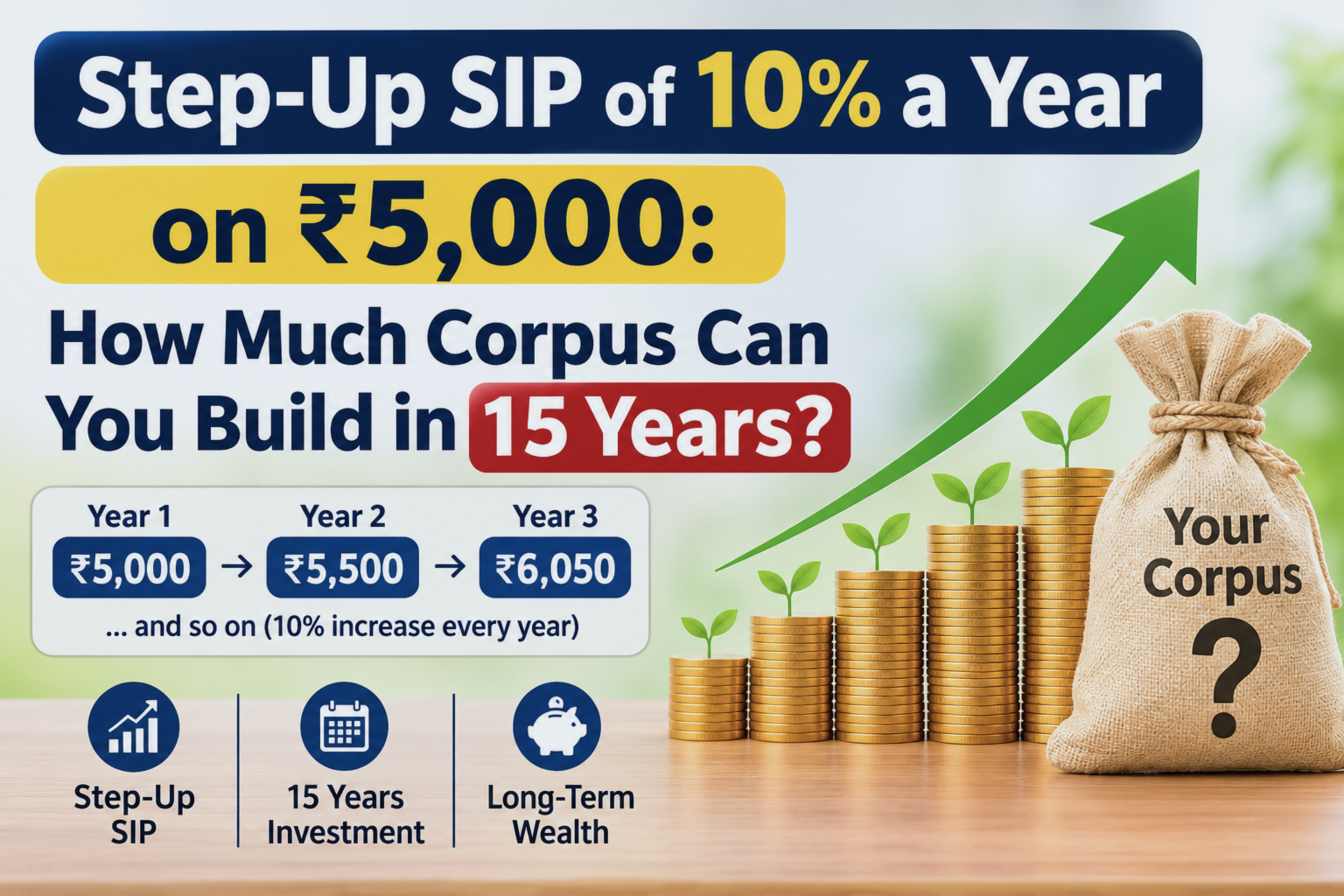
This is the core idea behind a Step-Up SIP, also widely known as a Top-Up SIP. It is an approach where your monthly SIP contribution increases by a fixed percentage every year. When paired with a modest starting amount like ₹5,000 per month and a consistent 10% annual step-up, the difference it may make to your long-term corpus — relative to a flat SIP — can be quite significant, as the illustrative projections in this article aim to demonstrate.
Whether you are just beginning your investment journey or looking to understand how to make an existing SIP more productive over time, this article aims to provide a thorough, balanced, and educational perspective on the Step-Up SIP strategy — with realistic caveats throughout.
What Is a Step-Up SIP?
A Step-Up SIP is a variant of the conventional Systematic Investment Plan where your monthly contribution increases at pre-defined intervals — usually once a year — by either a fixed rupee amount or a fixed percentage.
In a standard SIP, the monthly instalment remains unchanged throughout the investment period. If you start investing ₹5,000 a month today, you continue investing ₹5,000 a month in Year 10, regardless of how much your income may have grown. While a regular SIP is certainly a worthwhile habit, it may not fully reflect your increasing capacity to save as your career progresses.
A Step-Up SIP is designed to address this gap. With a 10% annual step-up, your contribution increases by 10% each year, automatically. These increments are gradual and are broadly intended to stay in line with typical annual income growth patterns among salaried individuals — though individual circumstances will naturally vary.
One important clarification worth emphasising early: the step-up feature only determines how much you invest each month. It does not control or guarantee investment returns in any way, as those remain entirely dependent on market performance, the fund(s) you choose, and prevailing economic conditions at any given time.
Many mutual fund platforms and AMC (Asset Management Company) websites in India now support the Step-Up SIP feature, allowing investors to configure their preferred annual increment percentage at the time of SIP creation, after which the adjustment operates automatically.
How a 10% Annual Step-Up Works — Year by Year
To understand the mechanics clearly, here is how your monthly SIP contribution would evolve over 15 years if you start with ₹5,000 and apply a 10% step-up each year. These figures are rounded to the nearest rupee for readability.
Year 1 — Monthly SIP: ₹5,000 | Annual Investment: ₹60,000
Year 2 — Monthly SIP: ₹5,500 | Annual Investment: ₹66,000
Year 3 — Monthly SIP: ₹6,050 | Annual Investment: ₹72,600
Year 4 — Monthly SIP: ₹6,655 | Annual Investment: ₹79,860
Year 5 — Monthly SIP: ₹7,320 | Annual Investment: ₹87,840
Year 6 — Monthly SIP: ₹8,052 | Annual Investment: ₹96,624
Year 7 — Monthly SIP: ₹8,857 | Annual Investment: ₹1,06,284
Year 8 — Monthly SIP: ₹9,742 | Annual Investment: ₹1,16,904
Year 9 — Monthly SIP: ₹10,717 | Annual Investment: ₹1,28,604
Year 10 — Monthly SIP: ₹11,788 | Annual Investment: ₹1,41,456
Year 11 — Monthly SIP: ₹12,967 | Annual Investment: ₹1,55,604
Year 12 — Monthly SIP: ₹14,264 | Annual Investment: ₹1,71,168
Year 13 — Monthly SIP: ₹15,690 | Annual Investment: ₹1,88,280
Year 14 — Monthly SIP: ₹17,259 | Annual Investment: ₹2,07,108
Year 15 — Monthly SIP: ₹18,985 | Annual Investment: ₹2,27,820
Total amount personally invested across 15 years: approximately ₹19.06 lakhs
A few points worth noting from these figures. In Year 2, the step-up adds only ₹500 more per month — a relatively modest increase for most salaried individuals. The increments feel progressively larger in the later years, but by that stage, an investor’s overall income and financial capacity will typically have grown as well. The strategy is structured to remain manageable across the full tenure, though personal financial circumstances should always guide any investment commitment.
Illustrative Corpus Projections Over 15 Years
The following projections are purely illustrative and are based entirely on assumed annualised rates of return. These figures are generated using standard financial calculators for educational and conceptual purposes only. Actual returns will vary — sometimes significantly — depending on market conditions, fund performance, and investment timing. These projections should under no circumstances be treated as expected, promised, or guaranteed outcomes.
Assumed Return: 10% Per Annum (Conservative Illustrative Scenario)
Useful for understanding possible outcomes if the portfolio performs at a relatively modest long-term pace, as might apply to categories such as large-cap or conservative hybrid funds.
- Total amount invested: approximately ₹19.06 lakhs
- Illustrative corpus at end of Year 15: approximately ₹35–37 lakhs
- Illustrative wealth gain from assumed market growth: approximately ₹16–18 lakhs
Assumed Return: 12% Per Annum (Moderate Illustrative Scenario)
This rate is commonly referenced as a standard benchmark in long-term equity SIP illustrations by financial planners and educational resources across India. It is important to note that this is not a prediction, forecast, or expectation — merely a widely used illustrative figure.
- Total amount invested: approximately ₹19.06 lakhs
- Illustrative corpus at end of Year 15: approximately ₹41–45 lakhs
- Illustrative wealth gain from assumed market growth: approximately ₹22–26 lakhs
Assumed Return: 15% Per Annum (Optimistic Illustrative Scenario)
This scenario represents a possible outcome where the portfolio benefits from sustained higher performance over a long period, as some diversified equity funds have historically delivered over extended horizons. This should be considered a relatively optimistic illustration and not a typical or expected outcome.
- Total amount invested: approximately ₹19.06 lakhs
- Illustrative corpus at end of Year 15: approximately ₹65–68 lakhs
- Illustrative wealth gain from assumed market growth: approximately ₹46–49 lakhs
An important note on interpretation: Even in the conservative 10% scenario, the illustrative figures reflect the potential impact of disciplined, gradually increasing contributions combined with long-term compounding. These numbers are designed solely to aid conceptual understanding — not to establish return expectations. Equity markets can and do deliver outcomes both above and below any assumed range, and there is no guarantee that any particular scenario will materialise.
Step-Up SIP vs. Regular SIP: An Educational Comparison
To understand the structural difference between both approaches, consider the following purely illustrative comparison. Both scenarios assume a starting amount of ₹5,000 per month, a 15-year horizon, and an assumed annualised return of 12% — for educational purposes only. These are not forecasts.
Scenario A — Regular SIP (₹5,000/month, unchanged throughout):
- Total amount invested: ₹9.0 lakhs
- Illustrative corpus: approximately ₹25–26 lakhs
Scenario B — Step-Up SIP (₹5,000/month with 10% annual increment):
- Total amount invested: approximately ₹19.06 lakhs
- Illustrative corpus: approximately ₹41–45 lakhs
The key observation here is that the Step-Up SIP requires a meaningfully higher total capital contribution — roughly double over the full 15 years. In return, the illustrative corpus is significantly larger, not simply because more money was invested in total, but because the larger contributions made in the later years also have time to benefit from compounding over their remaining investment period.
This comparison is not intended to suggest that one approach is universally superior to the other. The right strategy depends entirely on an individual’s income, monthly expenses, financial goals, risk tolerance, and personal circumstances. For someone managing constrained cash flows, maintaining even a regular SIP consistently is a genuinely valuable and commendable financial habit. The step-up approach works best for investors whose income is likely to grow steadily over time and who want their investment commitments to reflect that gradual increase.
Why Starting With ₹5,000 Is Perfectly Reasonable
A common misconception among newer investors is that a small monthly SIP amount is somehow insufficient to be worth starting. This thinking, in practice, often leads to inaction — which tends to be far more damaging to long-term wealth-building than starting with a modest amount.
Time is among the most significant variables in long-term compounding. An investor who begins a ₹5,000 Step-Up SIP at age 25 and maintains it consistently for 15 years will, in most illustrative scenarios, have an opportunity to build a meaningfully larger corpus than someone who waits until 28 or 30 hoping to start with a larger amount. The reason is relatively straightforward: earlier contributions have more years to potentially compound, even when the starting amounts are modest.
The Step-Up SIP structure is specifically designed to accommodate investors who may not have large investable surpluses in the early stages of their careers. As income gradually grows, so do the contributions — in an organic, structured manner that avoids placing excessive financial strain on monthly budgets. This is one of the more thoughtfully conceived features of this investment approach for retail investors.
Suitable Mutual Fund Categories for a Long-Term Step-Up SIP
Different mutual fund categories carry different risk profiles and have delivered varying return patterns historically. The right category depends on your individual investment horizon, risk tolerance, and financial objectives. The following is a broad, educational overview only — it does not constitute a fund recommendation of any kind.
For Investors With Higher Risk Tolerance and Long Horizons:
Mid-cap funds, small-cap funds, and flexi-cap funds have historically
demonstrated higher growth potential over extended periods, accompanied by
correspondingly higher short-term volatility. These are generally considered
more suitable for investors with a horizon of 10 years or more who are
comfortable with portfolio value fluctuations in the interim.
For Investors Seeking a More Balanced Approach:
Large and mid-cap funds, multi-cap funds, and ELSS (Equity Linked Savings
Scheme) funds aim to balance growth potential with relative portfolio
stability. ELSS funds additionally offer a potential tax deduction benefit under
Section 80C of the Income Tax Act, subject to applicable tax laws and
individual eligibility.
For Conservative or Risk-Averse Investors:
Large-cap index funds and balanced advantage funds (also referred to as dynamic
asset allocation funds) typically exhibit lower volatility compared to pure
equity categories, and may appeal to investors who prioritise relative capital
stability over aggressive long-term growth.
When evaluating any mutual fund for a long-term SIP, it is advisable to study the fund’s rolling returns over 5 and 10 years, its expense ratio, the experience and track record of its fund management team, and how the fund has performed across different market cycles — not just during favourable periods. Even a seemingly small difference in expense ratio can have a material impact on your net corpus over a 15-year period.
Please consult a SEBI-registered investment advisor for personalised fund selection guidance suited to your complete financial profile.
Practical Habits That Support Long-Term SIP Discipline
The strategy itself is conceptually straightforward. What tends to matter far more over a 15-year horizon is the consistency and discipline with which it is maintained. Some habits that many long-term investors and financial planners consider valuable:
- Configure the annual step-up at the time of SIP creation. Most platforms support this feature, allowing the annual increment to happen automatically without requiring manual action each year. If your platform does not support automation, setting a personal calendar reminder every year is a practical alternative.
- Align your SIP debit date with your salary credit date. This reduces the likelihood of fund insufficiency and builds the discipline of prioritising investment commitments before discretionary spending.
- Avoid interrupting your SIP during periods of market decline. When NAVs fall, your monthly instalment purchases a larger number of units, which may lower your average cost per unit over time. Maintaining SIP continuity through volatile periods is considered one of the structural benefits of the SIP mechanism.
- Review your investments once a year — not more frequently. An annual review allows you to assess whether your chosen fund continues to align with your goals, without encouraging reactive decision-making in response to short-term market movements.
- Invest any lump-sum windfalls thoughtfully. Bonuses, incentives, or occasional surplus income, when directed into your existing mutual fund portfolio, can contribute to your overall corpus growth without disrupting your regular monthly budget.
Common Mistakes That Investors Should Be Aware Of
Being aware of common pitfalls can be just as important as following the right strategy in the first place:
- Stopping SIP instalments during periods of market volatility. This can convert an unrealised decline into a permanent one and eliminates the benefit of continued unit accumulation at lower NAVs. Long-term investing perspectives generally suggest that staying invested through market cycles tends to be more conducive to wealth building than attempting to time entry and exit points.
- Overlooking the annual step-up on platforms that do not automate it. A simple personal reminder each year can help ensure the increment is applied consistently, keeping the investment on track with its original plan.
- Switching funds frequently on the basis of recent performance rankings. Fund performance rankings rotate across market cycles. Frequent switching can disrupt the compounding process, may trigger capital gains tax events, and often reflects short-term thinking that is generally at odds with the long-term nature of an equity SIP.
- Premature redemption for discretionary or non-urgent purposes. Withdrawing from a long-term equity portfolio earlier than planned can materially reduce the final corpus, particularly because the more pronounced effects of compounding typically tend to materialise in the later years of a 15-year investment period.
- Not accounting for tax implications at the time of redemption. Long-term capital gains on equity mutual funds exceeding ₹1.25 lakh per financial year are currently taxable at 12.5% (without the benefit of indexation), as per applicable rules at the time of writing. Short-term capital gains on units held for 12 months or less are currently taxed at 20%. Tax laws are subject to change, and their application can vary based on individual circumstances. It is strongly advisable to consult a qualified tax advisor before making redemption decisions.
Conclusion and Key Takeaways
The Step-Up SIP approach — starting at ₹5,000 per month with a 10% annual increment over 15 years — is, at its core, a disciplined framework for ensuring that your investment contributions grow in proportion to your income over time. It does not require a large initial capital outlay, nor does it suggest or promise extraordinary returns. What it offers, as demonstrated through the illustrative projections in this article, is a structured, manageable, and educationally sound approach to participating in long-term equity market growth through mutual funds.
Key Takeaways:
- A 10% annual step-up starting from ₹5,000/month leads to a contribution of approximately ₹18,985/month by Year 15.
- The total amount personally invested across 15 years comes to approximately ₹19.06 lakhs.
- At an assumed 12% annualised return (illustrative only), the possible corpus range is approximately ₹41–45 lakhs.
- Compared to a flat ₹5,000 SIP over the same period, the Step-Up SIP illustrates a meaningfully larger potential wealth accumulation — though this depends on actual market performance, which cannot be predicted.
- Consistency, patience, and avoiding reactive decisions during periods of market volatility are as important to the outcome as the strategy itself.
- All projections in this article are illustrative only. Actual results will differ based on real market performance, fund selection, and individual investment behaviour.
What to Consider Next: If the Step-Up SIP approach appears to align with your financial goals and risk profile, consider speaking with a SEBI-registered financial advisor. A qualified advisor can help evaluate suitable fund options, determine an appropriate step-up percentage based on your specific income trajectory, and structure your investments in a goal-oriented and tax-efficient manner. Starting early — even with a modest amount — is generally considered more beneficial in the long run than waiting for an ideal time, amount, or market condition.
📌 A Note on This Article: This article has been written and published solely for educational and informational purposes to help readers understand the concept of Step-Up SIPs and their illustrative long-term impact. The figures and projections presented here are based on assumed rates of return and standard financial calculation methods widely used for educational illustrations in Indian personal finance. They are not derived from any specific fund’s performance. Readers are strongly encouraged to verify all information independently and consult a SEBI-registered investment advisor for advice tailored to their individual financial circumstances, goals, and risk profile.
⚠️ Final Investment Disclaimer: All return projections and corpus figures mentioned in this article are purely illustrative, calculated using assumed rates of return for educational purposes only. Mutual fund investments are subject to market risks, and past performance of any fund or fund category does not guarantee future results. The actual corpus an investor may accumulate will depend on the specific fund(s) selected, prevailing market conditions throughout the investment period, the precise duration of investment, and several other factors that lie beyond any investor’s control. This article does not constitute investment advice of any kind. Please consult a SEBI-registered financial advisor before making any investment decision.
Frequently Asked Questions
1. What exactly is a Step-Up SIP, and how is it different from a regular SIP?
A Step-Up SIP (also called a Top-Up SIP) is a type of Systematic Investment Plan where the monthly contribution increases by a fixed percentage or fixed amount at a defined interval, typically once per year. In a regular SIP, the monthly instalment remains constant throughout the entire investment tenure. The key conceptual advantage of a Step-Up SIP is that it allows your investment amount to grow gradually alongside your income over time, which may lead to a larger corpus over the long term — as illustrated through the projections in this article. As with any investment, actual outcomes depend entirely on market performance and are not in any way guaranteed.
2. Is a 10% annual step-up achievable for a typical salaried employee in India?
For many salaried professionals in India, annual increments in the range of 8%–12% are reasonably common, though this varies considerably by industry, employer, role, seniority, and broader economic conditions. A 10% SIP step-up is designed to broadly mirror a portion of expected income growth — the idea being that investments grow without placing undue pressure on monthly budgets. That said, individuals should evaluate this entirely on the basis of their own financial situation and not assume any particular income growth trajectory going forward.
3. How do I set up a Step-Up SIP with a mutual fund platform?
Many mutual fund platforms and AMC (Asset Management Company) websites in India now offer a Step-Up or Top-Up SIP feature as part of their standard SIP creation process. When setting up a new SIP, you will typically find an option to specify an annual top-up — either as a percentage (such as 10%) or a fixed rupee amount. If configured, the platform applies this increment automatically on the anniversary of your SIP each year. If your chosen platform does not currently offer this automation, you have the option of manually modifying your SIP amount once a year by logging into your account and updating the instruction. It is advisable to verify the specific process with your chosen platform or AMC directly.
4. What happens if I am unable to increase my SIP for a particular year?
If the annual step-up is not applied for a year — whether due to a platform limitation, oversight, or a temporary financial constraint — your SIP simply continues at the current contribution amount without any interruption or penalty. The investment does not stop, and the account is not negatively impacted. The practical effect is a slightly lower final corpus compared to the original illustrative projection, since one year’s increment was not applied. The step-up can be resumed the following year. For long-term investors, maintaining the continuity of SIP contributions is generally considered more important than getting the step-up amount precisely right in every single year.
5. Should I continue my Step-Up SIP during a market downturn or bear market phase?
This is one of the most frequently asked and genuinely important questions for any long-term SIP investor. When equity markets decline, the NAV of equity mutual funds falls, which means your monthly SIP instalment acquires more fund units than it would during a rising market. This mechanism — commonly referred to as rupee cost averaging — can help lower your average cost per unit over time and may potentially enhance net returns during the subsequent market recovery. For this reason, most long-term investing guidelines suggest that continuing SIP contributions through downturns tends to be more beneficial than pausing or redeeming during periods of market stress. That said, every investor’s financial situation is different, and decisions of this nature should be made in careful consultation with a qualified financial advisor.
6. How are gains from an equity mutual fund Step-Up SIP taxed in India?
Under current Indian tax laws, equity mutual funds held for more than 12 months from the date of each unit’s purchase qualify for Long-Term Capital Gains (LTCG) treatment. LTCG exceeding ₹1.25 lakh per financial year is currently taxable at 12.5%, without the benefit of indexation. Gains on units held for 12 months or less are treated as Short-Term Capital Gains (STCG) and are taxed at 20%. It is worth noting that in a Step-Up SIP, each monthly instalment is treated as a separate purchase for the purpose of calculating holding period and applicable tax. Tax rules are subject to change by the government, and their precise application can vary based on individual circumstances and total income. Consulting a qualified tax advisor before making any redemption decisions is strongly recommended.
7. How should a beginner approach choosing the right mutual fund for a Step-Up SIP?
Selecting a mutual fund for a long-term SIP involves evaluating several factors in combination: your investment horizon, your risk tolerance, your financial goals, and the fund’s historical consistency across different market environments. Key metrics worth studying include rolling returns over 5 and 10 years (rather than point-to-point returns), the expense ratio, the AUM (Assets Under Management), and how the fund has performed relative to its benchmark during past market downturns. For first-time investors, beginning with a well-established diversified equity fund category — such as large and mid-cap or flexi-cap funds — before considering higher-risk categories is an approach many advisors consider prudent. A SEBI-registered investment advisor can provide personalised guidance based on your complete financial profile, goals, and risk capacity.