A few years ago, a colleague of mine smart guy, solid paycheck, two kids in middle school told me he wasn't really worried about retirement. He had a 401(k), he said. Things were "taken care of."
When I gently asked how much he'd actually saved, he paused. "Maybe sixty, sixty-five thousand? Something like that."
He was 43 years old.
That moment has stayed with me. Because here's what most people don't realize: it's not enough to just have a retirement account. What matters is whether the balance inside that account is actually aligned with what your future life is going to cost and that number looks completely different depending on how old you are right now.
Whether you're 26 and still paying off student loans, 38 and juggling a mortgage with your kid's college fund, or 52 and finally hitting your highest earning years, your retirement corpus target changes dramatically based on your current age. Same destination, very different paths to get there.
This article breaks it all down clearly, practically, and without the confusing finance-speak that makes most retirement content feel like homework.
Table of Contents
- What Is a Retirement Corpus, and Why Does It Matter?
- Why Your Current Age Changes Everything
- How a Retirement Corpus Calculator Based on Current Age Works
- The Formula Behind the Number
- Real-Life Examples: John, Robert, and Michael
- Age-Wise Monthly Savings Breakdown
- Common Mistakes Americans Make When Planning for Retirement
- Lesser-Known Tips to Build Your Corpus Faster
- Conclusion
- Frequently Asked Questions
What Is a Retirement Corpus, and Why Does It Matter?
Let's keep this simple.
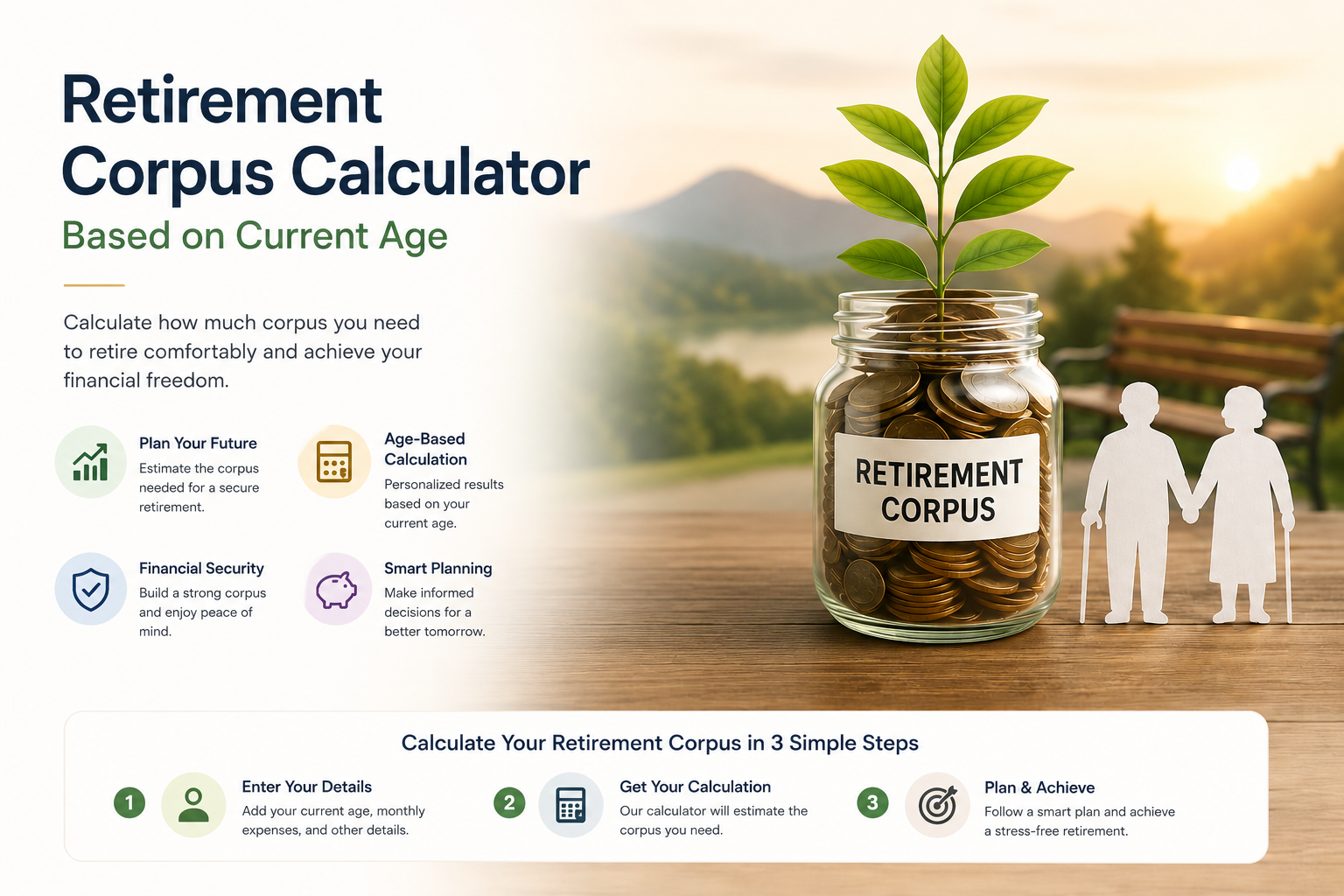
Your retirement corpus is the total pool of money you need saved and invested by the time you stop working so that you can live off it without a paycheck coming in every two weeks. It's not a vague, aspirational "big number." It's a specific, calculated target.
That target depends on four key things:
- Your expected monthly expenses once you retire
- How many years you'll actually spend in retirement
- The inflation rate quietly eroding your purchasing power
- The investment returns your savings keep generating even after you stop working
Here's what catches most people off guard: a million dollars sounds like financial security. And twenty years ago, it kind of was. But with a 3% annual inflation rate which is fairly typical for the United States the purchasing power of $1 million today shrinks to roughly $550,000 two decades from now. That's not a comfortable margin if you're planning to live another 25-30 years in retirement.
Getting your number right, and getting it right based on your age, is the entire point of this exercise.
Why Your Current Age Changes Everything
This is the core idea that too many retirement articles skim over. Age isn't just one variable in retirement planning it's the framework around which everything else gets built.
Your current age determines how many years compound interest can work in your favor, what level of investment risk actually makes sense, how aggressively you need to be saving right now, and whether your target retirement age is realistic at your current savings rate.
In Your 20s: The Compounding Advantage Nobody Talks About Enough
Retirement feels impossibly far away when you're 24 and trying to figure out rent, student loan payments, and whether you can actually afford that slightly nicer apartment. I get it. But this is genuinely the most powerful decade for your financial future.
The math is almost unfair in the best way. Someone who invests $300 per month starting at 25 will very likely end up with more at 65 than someone who invests $900 per month starting at 40. The only difference is time, and the compound interest it allows.
If you're in your 20s: start small, start now, and let time do most of the work.
In Your 30s: Good Intentions Stop Being Enough
Your 30s arrive fast. Suddenly there's a mortgage, maybe a spouse, maybe kids, car payments, and a creeping lifestyle upgrade that felt reasonable at the time. It gets crowded in a hurry.
The real danger here is lifestyle inflation income rises, but spending rises right alongside it. If you're earning more but not saving more, you're standing still in real terms.
Running a proper retirement corpus calculation in your 30s is genuinely eye-opening. Once you see the actual number you need to hit not a vague "save more" suggestion, but a real dollar figure the urgency tends to click into place.
In Your 40s: Catching Up Is Possible, But You Have to Move
Your 40s are often peak earning years, which is genuinely great. But if you've underfunded retirement up to this point, you need to redirect a meaningful chunk of that income toward making up lost ground.
This is also the decade where many Americans feel the "sandwich generation" squeeze supporting aging parents while still raising kids and carrying a mortgage. It's a lot. But your 65-year-old self needs you to keep retirement savings somewhere near the top of the priority list.
In Your 50s: Maximize, Minimize, and Stay Focused
By 50, the IRS actually gives you a hand you can make catch-up contributions to your 401(k) (an extra $7,500 per year as of 2024) and your IRA (an extra $1,000 per year). Use both.
This is also the time to pay down debt aggressively, trim lifestyle costs where you can, and gradually shift your portfolio toward a more balanced risk profile. The goal at this stage isn't growth at all costs it's protecting what you've built while still giving it room to grow.
How a Retirement Corpus Calculator Based on Current Age Works
Here's where a good calculator saves you hours of spreadsheet headaches.
The inputs matter more than the tool itself. Here's what you'll typically need to enter:
- Your current age The single most influential variable in the whole calculation
- Your planned retirement age 65 is the standard, but 60 or even 55 is increasingly common
- Your current monthly expenses Be honest here; optimistic numbers produce misleading results
- Expected inflation rate 3% is the standard U.S. assumption for planning purposes
- Expected investment return Historically, a diversified U.S. portfolio has averaged around 7-8% annually over long periods
- Life expectancy Plan conservatively; 85 to 90 is a reasonable range given current medical advances
If you want to do this exercise without building your own spreadsheet from scratch, the retirement corpus calculator at Finova Calc is worth a few minutes of your time it's straightforward, clearly laid out, and gives you a specific monthly savings target based on your current age and situation. The real value isn't the tool itself; it's the clarity that comes from finally seeing your actual number on the screen.
The Formula Behind the Number
You don't need to run this math manually every time. But understanding the logic helps you make smarter decisions and pushes back against oversimplified advice.
Step 1 Project your future monthly expenses:
Apply inflation to what you spend today. If you're spending $4,000 a month
right now and retiring in 25 years, at 3% inflation you'll need roughly $8,375
a month in future dollars to maintain a similar lifestyle.
Step 2 Estimate total retirement income needed:
Multiply your projected monthly need by 12, then by the number of years you
expect to be in retirement. If you retire at 65 and live to 85, that's 20 years
worth of living expenses.
Step 3 Apply the 4% withdrawal rule:
This is one of the most well-tested frameworks in American retirement planning.
The basic idea: you can withdraw 4% of your total corpus annually without
running out of money over a 30-year retirement. Which means: Target Corpus =
Annual Retirement Expenses ÷ 0.04. If you need $80,000 per year in retirement
income, your corpus target is $2,000,000.
Step 4 Subtract what you already have:
If you already have $130,000 in your 401(k), project its future value at your
expected return rate and subtract it from your target. The remaining gap is
what your ongoing contributions need to cover.
Real-Life Examples: John, Robert, and Michael
Same retirement goal roughly $1.5 million. Three completely different monthly savings requirements.
John, Age 25 Teacher in Ohio, Earning $52,000
John spends about $3,200 per month, has some student debt he's managing, and
wants to retire at 65. With 40 years of saving ahead of him, compound interest
is his greatest ally.
At an average 8% annual return, John needs to invest approximately $430 to $500 per month to reach a $1.5 million corpus. That's around 12-13% of his take-home pay. Ambitious, but achievable and starting now is genuinely the best financial decision he can make in his 20s.
Robert, Age 35 Project Manager in Texas, Earning $85,000
Robert has a mortgage, a car payment, and two kids whose college costs are
already keeping him up at night. He spends around $5,500 per month and also
wants to retire at 65. But with 30 years left instead of 40, the math shifts
significantly.
To hit the same $1.5 million target, Robert needs to save roughly $1,100 to $1,300 per month. More than double what John needs despite having only a 10-year head start. His total lifetime contributions will also be higher, because compound interest has had less time to carry the load.
Michael, Age 45 Regional Sales Manager in Florida, Earning $110,000
Michael earns well. But he's also spent the last 20 years enjoying it
vacations, a bigger house, a boat he barely uses. His retirement savings
currently sit at around $95,000. He has 20 years to close the gap.
Accounting for the projected growth of his existing $95,000, Michael still needs to contribute around $2,000 to $2,400 per month in fresh savings to reach $1.5 million by 65. His income can handle it but only if he makes retirement the priority, not the afterthought.
The gap between John and Michael's required monthly savings is nearly $2,000. That's the financial cost of a 20-year delay.
Age-Wise Monthly Savings Breakdown
These are starting-point guidelines based on a middle-class American lifestyle, a retirement age of 65, and a conservatively estimated average return of 7-8%.
- Ages 20-25: Aim for 10-15% of gross income. Even $200-$400 per month in a growth-oriented index fund will compound dramatically over four decades.
- Ages 25-35: Push to 15-20%. This is when lifestyle inflation becomes the biggest threat. Keep your spending anchored even as your income grows.
- Ages 35-45: Target 20-25% or more. Maximize your 401(k) contributions ($23,000 per year in 2024) and seriously consider a Roth IRA for tax-free growth later.
- Ages 45-55: Aim for 25-35% of income. If you're behind, this is your primary catch-up window. Use every available IRS contribution limit.
- Ages 55-65: Prioritize debt payoff, reduce discretionary spending, and protect what you've built. Every extra year of contributions at this stage has an outsized positive impact on your final corpus.
Common Mistakes Americans Make When Planning for Retirement
These patterns show up constantly and most of them are completely avoidable.
Overestimating what Social Security will cover. The average Social Security benefit in 2024 is around $1,700-$1,900 per month. That covers basic expenses in some parts of the country but it's not a retirement plan on its own. Treat it as a supplement, not a foundation.
Planning only to age 80. Medical advances are real. Many people are now living well into their late 80s and 90s. If your corpus only lasts to 80 and you live to 88, the final years get very difficult very fast. Plan to at least 85-90 to build in a reasonable buffer.
Completely ignoring healthcare costs. Fidelity estimates that a retired couple will need roughly $315,000 in today's dollars just for healthcare expenses throughout retirement and that's not counting long-term care. This almost never gets factored into basic retirement estimates.
Letting lifestyle inflation swallow your raises. Every salary bump tends to come with an upgrade nicer car, bigger home, more subscriptions, more dining out. If your savings rate isn't increasing alongside your income, you're moving backward despite earning more.
Dipping into retirement accounts early. That 10% early withdrawal penalty, plus ordinary income tax on the amount withdrawn, can effectively erase years of growth in a single transaction. Treat retirement accounts as untouchable until retirement.
Lesser-Known Tips to Build Your Corpus Faster
Most retirement articles recycle the same standard advice. Here are a few things that don't get nearly enough attention.
Automate annual savings increases. Most 401(k) plans have a feature that lets you automatically increase your contribution rate by 1-2% each year. It's small enough that you barely feel it month to month, but over 20-30 years it creates a dramatically larger corpus. If your plan doesn't offer this, set a calendar reminder every January to bump it manually.
Think carefully about when to claim Social Security. Every year you delay claiming Social Security past your full retirement age up to age 70 your monthly benefit increases by about 8%. This isn't about working longer. It's about timing. If you have other income sources in your early retirement years, waiting on Social Security can add tens of thousands of dollars in lifetime benefits. Most people claim too early without running the numbers.
Consider a part-time income bridge in early retirement. Even generating $1,500-$2,000 per month from consulting, freelance work, or part-time employment in the first five years of retirement dramatically reduces pressure on your corpus. For people who enjoy staying engaged and active, this can make the difference between a comfortable retirement and a stressful one without requiring years of additional full-time work.
Don't count home equity as your retirement plan. A lot of Americans mentally add their home's value to their retirement corpus. It can be a resource in a pinch but it shouldn't be the foundation. Housing markets fluctuate, selling has real costs, and you still need somewhere to live. Build your corpus independent of home equity.
Conclusion
Retirement planning isn't about depriving yourself today. It's about buying your future self the freedom to choose the choice to stop working when you want to, not when you have to.
But that freedom has a price tag, and that price looks very different depending on how old you are right now.
John at 25 invests $500 a month and builds a deeply comfortable retirement. Michael at 45, starting from roughly the same place, needs nearly five times that monthly contribution to reach a similar outcome. Same goal. Wildly different effort required. The only variable that changed is age.
The most important thing isn't finding the perfect retirement plan. It's getting an actual plan and starting to work it now, with whatever you currently have.
Know your target number. Run the calculation for your specific age. Adjust your savings rate each year until you're on track. Your retirement corpus calculator based on current age gives you the map. What you do next determines whether you actually reach the destination.
Frequently Asked Questions
1. How much should I have saved for retirement by age 40?
A practical benchmark is to have roughly 3x your annual salary saved by 40. So
if you earn $70,000 per year, you'd want around $210,000 saved by your 40th
birthday. This isn't a rigid rule everyone's situation differs but it's a
useful gut-check. If you're below this benchmark, the answer isn't panic it's
increasing your savings rate now and running a detailed projection to
understand your actual gap.
2. What is the 4% rule, and should I still use it?
The 4% rule suggests you can withdraw 4% of your total retirement portfolio
annually without exhausting your money over a 30-year retirement. A $1.5
million corpus, for example, would generate $60,000 per year in withdrawals.
It's based on decades of U.S. market data and remains a widely used planning
tool. Some advisors now recommend 3-3.5% withdrawal rates given longer life
expectancies and current market conditions. Either way, it's a solid starting
framework.
3. Should I prioritize paying off debt or saving for retirement?
The best answer is usually: do both, in a specific order. Always contribute at
least enough to your 401(k) to capture your full employer match that's an
instant 50-100% return that you genuinely should not leave on the table. After
that, pay down high-interest debt aggressively anything above 6-7% interest
rate. Low-interest debt like a fixed-rate mortgage can realistically coexist
with solid retirement savings.
4. How does Social Security factor into my retirement corpus
calculation?
Think of Social Security as a partial income stream that reduces how much your
corpus needs to cover not as a retirement plan by itself. Get your personalized
benefit estimate directly from the Social Security Administration at ssa.gov. Subtract
your expected annual Social Security income from your total annual retirement
expenses. The remaining gap is what your corpus actually needs to generate.
5. What's the most effective investment approach for building a
retirement corpus in the U.S.?
Start with your employer's 401(k), especially if there's any company match. Add
a Roth IRA for tax-free growth and withdrawal flexibility. For the investment
mix inside those accounts, low-cost index funds tracking the S&P 500 or
total market are a proven, cost-efficient foundation for long-term growth. As
you move within 10-15 years of retirement, begin gradually shifting toward a
more balanced allocation that includes bonds and dividend-producing
investments.
6. I'm 50 with very little saved. Is it genuinely too late?
No but honesty about the math matters. With 15 years until 65 and a focused
effort, building a meaningful corpus is still very possible. Use the IRS
catch-up contribution limits an extra $7,500 per year in your 401(k) and $1,000
extra in your IRA. Cut major discretionary expenses and redirect that money
directly into retirement accounts. Working two or three additional years beyond
65 also makes a substantial difference not just because of additional savings,
but because it shortens the number of years your corpus needs to last.
7. How often should I recalculate my retirement corpus target?
Once a year is a solid minimum tying it to tax season or your annual
performance review works well as a habit anchor. But also revisit it after any
major life change: a significant salary increase, a new child, buying or
selling a home, or a major shift in monthly expenses. Your retirement plan
should evolve with your life, not sit untouched in a spreadsheet from 2019.