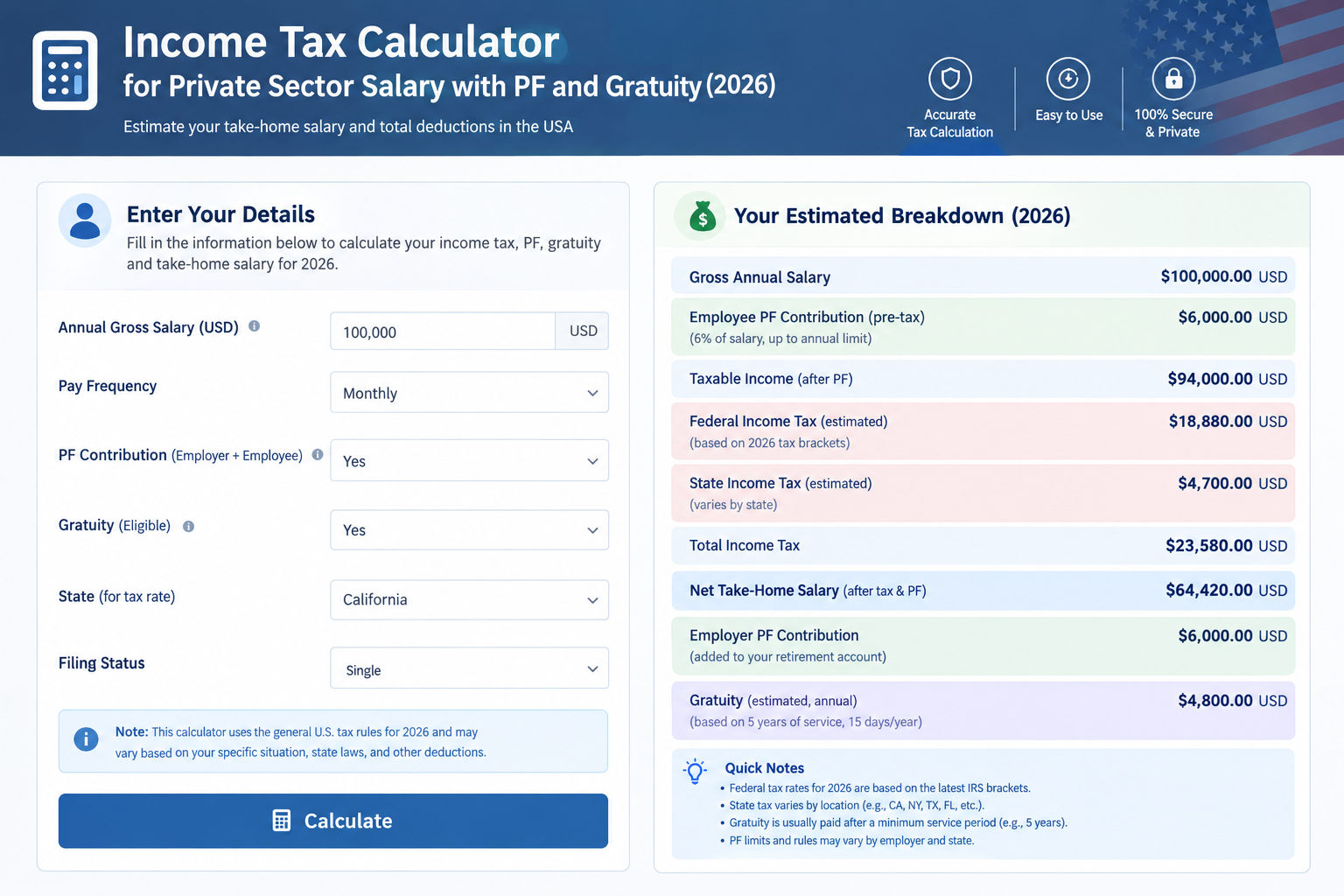
Disclaimer: This article is for informational purposes only and does not constitute tax, legal, or financial advice. Tax laws change, and individual situations vary. Please consult a qualified tax professional or visit IRS.gov for guidance specific to your situation.
If you work in the US private sector and your total compensation includes retirement plan contributions and occasional payments like bonuses or service gratuity, calculating your federal income tax can feel like a puzzle. There are more moving parts than most people realize and getting even one piece wrong can mean a surprise balance due in April or money left on the table all year.
The process becomes significantly clearer once you understand how the IRS treats each component of your pay. With 2026 bringing updated federal income tax brackets and a higher standard deduction, there's genuine opportunity to reduce what you owe if you approach your compensation planning thoughtfully throughout the year.
This guide walks through how to calculate your 2026 federal income tax as a US private sector employee, covering how pre-tax retirement contributions (the American equivalent of a Provident Fund) reduce your taxable income, how gratuity and end-of-service payments are handled under IRS rules, and how to run the full calculation with a realistic, step-by-step example.
Table of Contents
- What the IRS Considers Taxable Salary Income
- PF in the US Context - How Pre-Tax Retirement Contributions Work
- How Gratuity and End-of-Service Payments Are Taxed
- 2026 Federal Income Tax Brackets and Standard Deduction
- Step-by-Step: How to Calculate Your Federal Tax
- Real-Life Example $75,000 Salary with Retirement Contributions and Gratuity
- Deductions Private Sector Employees Often Overlook
- Practical Strategies to Lower Your 2026 Tax Bill
- Conclusion and Key Takeaways
- Frequently Asked Questions
What the IRS Considers Taxable Salary Income
Your tax calculation starts with an accurate total of everything you earned during the year. For private sector salaried employees, the IRS treats the following as ordinary taxable income:
- Base annual salary
- Performance bonuses and incentive pay
- Commission earnings and overtime
- Gratuity and end-of-service payments (in most circumstances)
- Employer-paid allowances not excluded by law
- Taxable fringe benefits that don't qualify for a specific IRS exclusion
The general principle is simple: if your employer transfers money or equivalent value to you in any form, it's taxable unless a specific IRS rule says otherwise. This matters when you receive one-time payments during the year that don't show up clearly on monthly pay stubs.
Your total gross income is the starting point for every calculation that follows.
PF in the US Context - How Pre-Tax Retirement Contributions Work
A Provident Fund, or PF, is a government-managed retirement savings system used in countries like India, where both employees and employers contribute mandatorily with certain tax advantages attached. The United States has no direct equivalent to this structure. For US private sector employees, the closest comparison is the traditional 401(k) plan along with similar pre-tax vehicles like the 403(b) or SIMPLE IRA.
What makes these accounts significant for your tax bill is the pre-tax treatment of contributions. When you contribute to a traditional 401(k), those dollars are deducted from your gross compensation before federal income tax is applied. That directly reduces your taxable income for the year.
2026 Contribution Limits
The IRS has set the following employee contribution limits for 2026:
- $23,500 for employees under age 50
- $31,000 for employees aged 50 and older (including a $7,500 catch-up contribution)
Employer matching contributions are separate and don't count against your personal limit. If your employer matches and you aren't contributing enough to capture the full match, you're leaving compensation unclaimed.
Traditional vs. Roth Contributions
Not all retirement contributions reduce your 2026 tax bill. Roth 401(k) contributions use after-tax dollars, so they don't lower your taxable income now. The payoff comes later qualified withdrawals in retirement are generally tax-free. This article focuses on traditional pre-tax contributions, since those create an immediate reduction in your current-year federal tax liability.
How Gratuity and End-of-Service Payments Are Taxed
In the US, the term "gratuity" applies to different situations. Here's how each is handled for tax purposes.
Employer Recognition and End-of-Service Payments
When an employer provides a lump-sum payment for reaching a service milestone, upon retirement, or at the end of employment, the IRS treats it as ordinary income. That payment gets added to your gross income for the year and taxed at your regular federal rate just like your salary.
One limited exception: non-cash employee achievement awards given through a qualified employer plan may be excluded from income up to $1,600 per year. Cash payments, bonuses, and most standard recognition payments don't qualify and are fully taxable.
Tips in the Service Industry
For workers in hospitality or food service, customer tips are also fully taxable. The IRS requires all tip income to be reported to your employer, who includes it on your W-2. There's no minimum amount every dollar in tips must be reported.
How a Gratuity Affects Your Tax Calculation
A one-time gratuity increases your gross income in the year you receive it. If it pushes some income into a higher bracket, only the amount above that bracket's threshold is taxed at the higher rate not your full income. Still, it's worth accounting for these payments when planning your annual pre-tax contributions.
2026 Federal Income Tax Brackets and Standard Deduction
The US uses a progressive tax system. Income is divided into layers, and each layer is taxed at the rate assigned to that specific bracket not at one flat rate applied across your full income.
2026 Tax Brackets - Single Filers
- 10% on income from $0 to $12,400
- 12% on income from $12,401 to $50,400
- 22% on income from $50,401 to $105,700
- 24% on income from $105,701 to $201,775
- 32% on income from $201,776 to $256,225
- 35% on income from $256,226 to $640,600
- 37% on income above $640,600
For married couples filing jointly, the income thresholds are roughly double through most brackets.
2026 Standard Deduction
- $16,100 for single filers
- $32,200 for married filing jointly
These figures are higher than prior years due to inflation adjustments. Most private sector employees find the standard deduction exceeds their total itemizable expenses, making it the simpler and more beneficial choice.
Step-by-Step: How to Calculate Your Federal Tax
Follow these steps to estimate your 2026 federal income tax liability.
Step 1 - Total Your Gross Income
Add your base salary, bonuses, commissions, gratuity payments, overtime, and
any other taxable compensation received during 2026.
Step 2 - Subtract Pre-Tax
Contributions to Get Your AGI
Deduct contributions to a traditional 401(k), pre-tax health insurance
premiums, HSA contributions, Dependent Care FSA, and other qualifying pre-tax
payroll deductions. The result is your Adjusted Gross Income, or AGI.
Step 3 - Subtract the Standard
Deduction
Subtract $16,100 (single) or $32,200 (married filing jointly), or your total
itemized deductions if they exceed that amount. What remains is your taxable
income.
Step 4 - Apply the 2026 Tax Brackets
Multiply the income within each bracket by the corresponding rate, then add the
results together to get your total federal tax liability before credits.
Step 5 - Subtract Any Eligible Tax
Credits
Credits reduce your tax bill dollar for dollar they're more valuable than
deductions. Common credits include the Child Tax Credit, the Child and
Dependent Care Credit, and for qualifying lower-income filers, the Retirement
Savings Contributions Credit, also called the Saver's Credit.
Real-Life Example - $75,000 Salary with Retirement Contributions and Gratuity
Here's a step-by-step calculation using accurate 2026 numbers.
Jordan's Situation:
- Annual base salary: $75,000
- Gratuity (5-year service recognition): $3,500
- Traditional 401(k) contribution: $9,000
- Pre-tax health insurance premiums (payroll deduction): $2,200
- Filing status: Single
Step 1 - Gross Income
$75,000 + $3,500 = $78,500
Step 2 - Pre-Tax Deductions (AGI)
$78,500 − $9,000 − $2,200 = $67,300 AGI
Step 3 - Standard Deduction
$67,300 − $16,100 = $51,200 taxable income
Step 4 - Applying the 2026 Brackets
- 10% on $0–$12,400 → $12,400 × 10% = $1,240
- 12% on $12,401–$50,400 → $38,000 × 12% = $4,560
- 22% on $50,401–$51,200 → $800 × 22% = $176
Total Federal Income Tax = $5,976
Marginal Rate vs. Effective Rate
Jordan's marginal tax rate the highest bracket reached is 22%. But the average rate applied to Jordan's taxable income is about 11.7%. These are genuinely different numbers. Being "in the 22% bracket" does not mean 22 cents of every dollar earned goes to federal tax.
The Real Impact of Pre-Tax Contributions
Without the $9,000 401(k) contribution, Jordan's taxable income would have been $60,200. That additional $9,000 falls entirely within the 22% bracket, meaning the tax bill increases by $1,980 rising to approximately $7,956. The pre-tax retirement contribution alone saved Jordan nearly $2,000 in federal income taxes while also building long-term retirement savings.
A note on the Saver's Credit: Jordan's AGI of $67,300 exceeds the income threshold for the Retirement Savings Contributions Credit, which phases out at approximately $40,250 for single filers in 2026. Jordan does not qualify for that credit at this income level. The retirement contribution still delivers significant savings through the reduced taxable income it just doesn't produce an additional credit in this scenario.
Deductions Private Sector Employees Often Overlook
Beyond the standard deduction and 401(k) contributions, a few additional deductions are worth checking before you file.
Student Loan Interest - You can deduct up to $2,500 in qualified student loan interest paid during the year. This deduction reduces your AGI directly and is available even if you take the standard deduction, subject to income phase-out limits.
Health Savings Account Contributions - If you're enrolled in a qualifying High Deductible Health Plan, HSA contributions are tax-deductible, grow tax-free, and can be withdrawn tax-free for qualified medical expenses. The 2026 limit is $4,300 for self-only coverage and $8,550 for family coverage.
Educator Expenses - K–12 educators at qualifying private schools can deduct up to $300 in unreimbursed classroom expenses without itemizing.
Charitable Contributions - If you do itemize, cash donations to qualified nonprofits are deductible. Written acknowledgment is required for any gift of $250 or more.
State and Local Tax Deduction (SALT) - Itemizers can deduct up to $10,000 in combined state income taxes and local property taxes under current law.
Practical Strategies to Lower Your 2026 Tax Bill
These approaches are legal, straightforward, and accessible to most private sector employees.
Increase Your 401(k) Contribution
Rate
Every additional pre-tax dollar you contribute directly lowers your taxable
income. In Jordan's example, $9,000 in contributions produced nearly $2,000 in
federal tax savings. If you're in the 22% bracket, each additional $1,000
contributed saves $220 in federal tax for the year. Even a modest increase in
your contribution rate adds up over twelve months.
Open or Fund an HSA
If you're eligible, the HSA is one of the most tax-efficient tools available to
American workers. Contributions are deductible, growth is tax-free, and
qualified withdrawals are also tax-free. Many eligible employees simply never
open one.
Plan Around Large One-Time Payments
If you expect a significant bonus or gratuity in a given year, consider whether
increasing your retirement contributions during that period makes sense. You
won't avoid tax on the payment, but you can offset some of it and reduce how
much income enters a higher bracket.
Check Whether You Qualify for the
Saver's Credit
If your AGI is below approximately $40,250 as a single filer, the Retirement
Savings Contributions Credit rewards you for contributing to a retirement
account. The credit ranges from 10% to 50% of your first $2,000 in
contributions, depending on your income level. File Form 8880 to claim it it's
often missed by workers who qualify.
Verify Your Withholding Is Accurate
Use the IRS Tax Withholding Estimator at IRS.gov to confirm whether your current
paycheck withholding aligns with what you'll actually owe. Under-withholding
leads to a balance at filing and potentially a penalty if the gap exceeds
$1,000.
Consider Speaking with a Tax
Professional Before Year-End
Filing taxes and planning taxes are two different things. A CPA or Enrolled
Agent can review your salary, bonuses, gratuity, and retirement contributions
before December 31st when most planning opportunities close for the year.
Conclusion and Key Takeaways
Calculating your 2026 federal income tax as a US private sector employee comes down to a clear process: identify all taxable income sources, reduce your gross income through legitimate pre-tax deductions, apply the standard deduction, and run what remains through the correct brackets.
Jordan's example demonstrates how meaningful that process can be. On $78,500 in gross income including a $3,500 gratuity a $9,000 pre-tax 401(k) contribution reduced the federal tax bill by nearly $2,000 while simultaneously building retirement savings. That outcome comes from understanding how compensation and tax rules work together, not from any complicated strategy.
Here are the key points to remember:
- Salary, bonuses, and gratuity payments are all generally taxable as ordinary income in the year received
- Traditional 401(k) contributions reduce taxable income immediately every additional dollar contributed saves money at your marginal rate
- The 2026 standard deduction is $16,100 for single filers and $32,200 for married filing jointly
- Tax brackets are marginal higher rates apply only to income within that bracket, not your total earnings
- The Saver's Credit is available for lower-income earners and frequently goes unclaimed
- Planning throughout the year is more effective than trying to minimize taxes at filing time
If your situation involves larger bonuses, equity compensation, or significant gratuity income, a qualified tax professional can review the specifics and identify opportunities that a general article can't cover.
This article is for informational purposes only and does not constitute tax, legal, or financial advice. Tax laws change, and individual situations vary. Please consult a qualified tax professional or visit IRS.gov for guidance specific to your situation.
Frequently Asked Questions
1. Is a gratuity payment taxable
income for US private sector employees in 2026?
Yes, in most cases. Cash gratuity payments whether they're end-of-service
bonuses, long-service awards, or retirement recognition payments are treated by
the IRS as ordinary income. They're added to your gross income and taxed at
your regular federal rate. Certain non-cash achievement awards through a
qualified employer plan may be excluded up to $1,600 per year, but cash
payments are almost always fully taxable.
2. What is the US equivalent of a
Provident Fund for tax purposes?
The US has no mandatory Provident Fund system. For private sector employees,
the closest equivalent is the traditional 401(k), which allows pre-tax
contributions that reduce taxable income in the year they're made. The 403(b)
and SIMPLE IRA serve a similar function in certain employer settings.
3. How exactly do 401(k)
contributions lower my 2026 federal tax bill?
Traditional 401(k) contributions are deducted from gross compensation before
federal income tax applies. If you earn $78,500 and contribute $9,000 to a
traditional 401(k), the IRS taxes you on $69,500, not $78,500. Tax on that
$9,000 is deferred until you withdraw the funds in retirement when you may be
in a lower bracket.
4. What are the correct 2026 federal
income tax brackets for single filers?
The brackets for single filers are: 10% on income up to $12,400; 12% on
$12,401–$50,400; 22% on $50,401–$105,700; 24% on $105,701–$201,775; 32% on
$201,776–$256,225; 35% on $256,226–$640,600; and 37% on income above $640,600.
Only the income within each range is taxed at that rate.
5. What is the 2026 standard
deduction?
The standard deduction is $16,100 for single filers and $32,200 for married
couples filing jointly. Most private sector employees find the standard
deduction exceeds their itemizable expenses, making it the simpler and often
more beneficial choice.
6. Who qualifies for the Saver's
Credit in 2026?
The Saver's Credit rewards lower-income workers for contributing to qualifying
retirement accounts. For single filers, the credit phases out completely above
approximately $40,250 in AGI. It can be worth up to 50% of the first $2,000 in contributions
at the lowest income level. Use IRS Form 8880 to determine whether you qualify
and to claim the credit.
7. If a large gratuity pushes me
into a higher bracket, does all my income get taxed at the new rate?
No. The US tax system is marginal, meaning only the income above a bracket
threshold is taxed at the higher rate. If your taxable income reaches $52,000,
only the $1,600 above the $50,400 threshold is taxed at 22%. Your income below
that threshold continues to be taxed at 10% and 12%, respectively. A gratuity
payment can push some additional income into a higher bracket without changing
the rate applied to everything else you've earned.