A quick note before we dive in: This article is for general informational and educational purposes only. It is not professional financial, tax, or legal advice. Tax rules vary by country, state, and individual situation so always consult a qualified professional for guidance specific to your circumstances. That said, what you're about to read is genuinely practical, and most of it applies broadly regardless of where you live.
Picture this. It's the last week of the tax year. You're staring at 12 months of bank statements, trying to work out which transactions were for your business and which were just... life. That dinner was that a client meeting or a birthday? That software subscription personal or professional?
If that sounds painfully familiar, you're not alone. Mixing personal and business money is probably the most common financial mistake that freelancers, side-hustlers, and new business owners make. Not because they're careless but because nobody tells them what to actually do about it, and hiring an accountant feels like a step too far when you're still figuring things out.
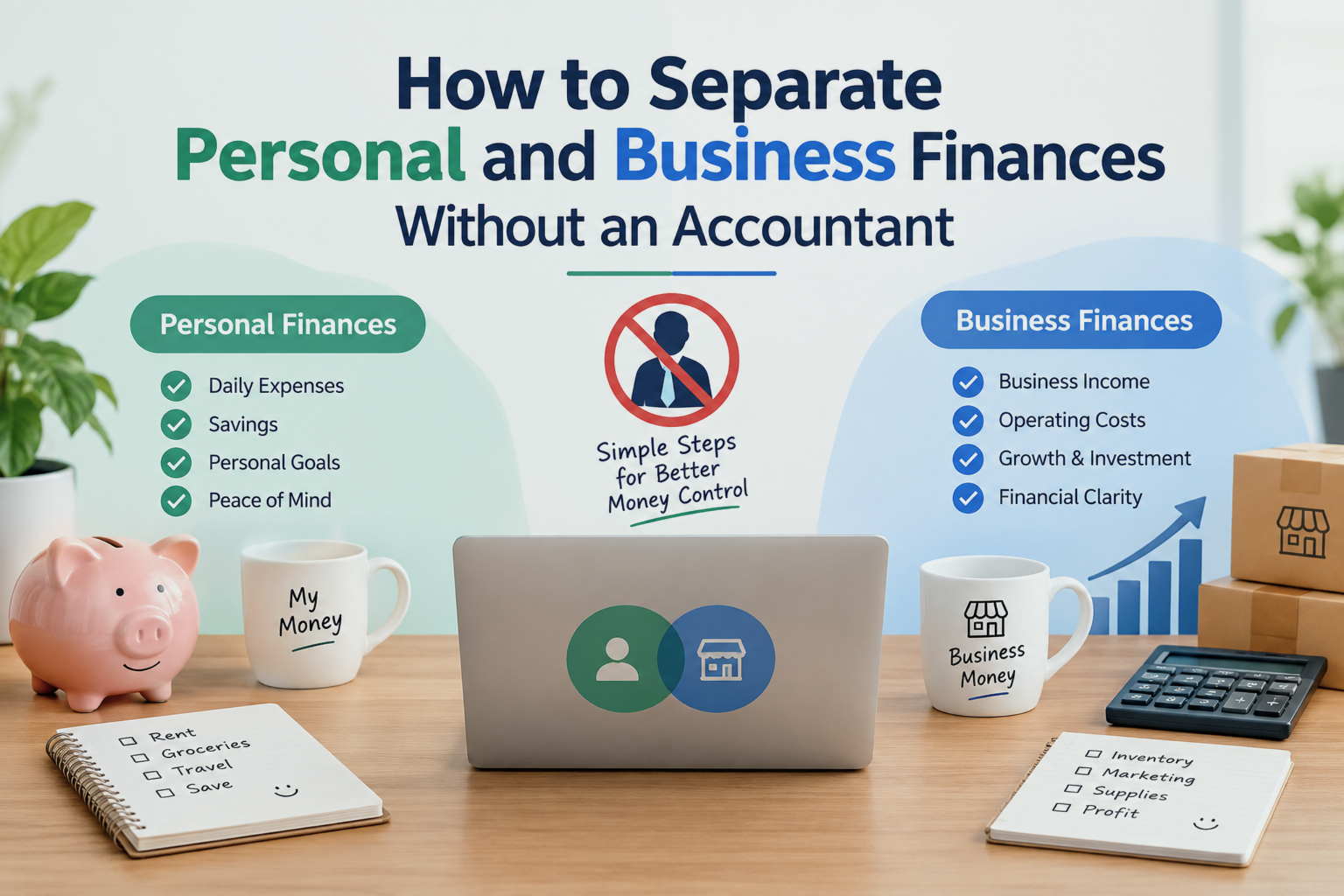
Here's the truth: you don't need an accountant to get your finances properly separated. You need a clear system, a handful of the right (often free) tools, and about an hour of your time this weekend. This guide walks you through all of it step by step, in plain English, with no fluff.
Table of Contents
- Why This Actually Matters More Than You Think
- Step 1 - Open a Dedicated Business Bank Account
- Step 2 - Get a Business Credit Card
- Step 3 - Pay Yourself a Fixed Amount Every Month
- Step 4 - Pick a Bookkeeping Tool You'll Actually Use
- Step 5 - Build a Receipt System That Doesn't Fall Apart
- Step 6 - Understand Self-Employment Tax Basics
- Step 7 - Start a Business Emergency Fund
- Common Mistakes (And How to Avoid Them)
- Your 7- Day Action Plan
- Frequently Asked Questions
Why This Actually Matters More Than You Think
Most people treat this like a tidiness issue like keeping your desk clean. But tangled finances cause real, costly problems that go well beyond aesthetics.
Tax time becomes brutal. When personal and business transactions share one account, every expense becomes a question mark. You'll either miss legitimate deductions because you can't tell what was business-related, or you'll claim things you shouldn't and risk problems during an audit.
You can't see your actual profit. If you don't know what your business is truly earning and spending, you're making decisions in the dark. Growth becomes guesswork.
Your legal protection can disappear. If you've formed an LLC or similar entity for liability protection, consistently mixing funds with personal accounts can "pierce the corporate veil" a legal concept that strips away those protections if your business ever faces a lawsuit.
Cash flow becomes a mystery. Dipping into one pot for both personal needs and business expenses means you never really know if your business can sustain itself. That uncertainty is stressful, and it holds people back from growing with confidence.
Separating finances isn't just good housekeeping. It's the foundation everything else is built on.
Step 1 - Open a Dedicated Business Bank Account
This is non-negotiable, and it's your first move. Everything else flows from here.
The good news is that opening a business bank account has never been easier or cheaper. Many of the best options are completely free.
Solid options to consider:
- Relay - Free, no minimum balance, excellent for freelancers. Lets you create multiple sub-accounts (handy for setting aside taxes). Downside: US-only, no physical branches.
- Bluevine - Free with interest on your balance. Good if your business holds larger cash reserves. Downside: Limited cash deposit options.
- Mercury - Very popular with early-stage businesses, clean interface, no fees. Downside: Not FDIC-insured directly -funds are held through partner banks.
- Traditional banks (Chase, Wells Fargo, etc.) - More accessible with physical locations. Downside: Often have monthly fees and minimum balance requirements.
For most sole proprietors and freelancers, a free online business account like Relay or Mercury is more than enough.
What you'll typically need to open one:
- Government-issued ID
- Your business name (even if that's just your own name as a sole proprietor)
- A tax ID either an EIN or your personal Social Security/National Insurance number depending on your country and business structure
- Initial deposit (often $0)
Once it's open, make this your iron rule: all business income comes in here, all business expenses go out from here. Treat it like a sacred boundary.
Step 2 - Get a Business Credit Card
A dedicated business credit card is the second pillar of clean finances. Every business purchase runs through one card which means one statement, one clean record, and at the end of the year, your card provider often generates a category summary that's incredibly useful for taxes.
What to look for in a business card:
- No annual fee (at least to start)
- Clear spending categories in the app
- A rewards structure that matches how you actually spend
The Chase Ink Business Cash and Capital One Spark Cash Select are widely recommended for small business owners both have no annual fee and straightforward cash-back structures.
The golden rule: Pay it off in full every month. This card exists to track spending and build business credit not to carry debt. If you can't pay it in full, you're spending money your business doesn't have yet.
Step 3 - Pay Yourself a Fixed Amount Every Month
This is the step that trips people up most. Without a set process, it's too easy to transfer "a bit" from the business account whenever you need personal cash -and suddenly the lines are blurred again.
The solution is simple: pay yourself like you're your own employee.
Here's a basic formula to find your number:
- Calculate your average monthly business income over the past 3-6 months
- Subtract your average monthly business expenses
- Set aside 25-30% of what's left for taxes (see Step 6)
- From the remainder, transfer a consistent, fixed amount to your personal account same day every month
This is called an owner's draw for sole proprietors, or a salary if you've formed a corporation. The structure differs by business type, so check what applies to your situation but the principle stays the same.
Your number will likely need adjusting over time, and that's completely fine. What matters is having a system instead of just grabbing money when you need it.
Step 4 - Pick a Bookkeeping Tool You'll Actually Use
Plenty of people download a bookkeeping app, set it up once, and never open it again. The best tool is the one that fits your workflow and your budget not the one with the most features.
Here are four options worth knowing about:
- Wave - Completely free, and genuinely useful. It connects to your bank accounts, tracks income and expenses, and even handles invoicing. The main catch is that customer support on the free plan is limited. But for most freelancers just starting out, it's more than enough.
- QuickBooks Self-Employed - Costs around $15/month, but it comes with automatic mileage tracking, which is a big deal if you use your car for business. The downside is that reporting options are fairly basic compared to the price.
- FreshBooks - A great pick if you regularly send invoices to clients. It's clean, easy to use, and handles time tracking well. Starting from around $17/month, though it can get pricier as your client list grows.
- Xero - The most powerful of the bunch, starting around $13/month. Better suited for businesses that are growing and need deeper financial reporting. The learning curve is steeper, so it's probably overkill if you're just getting started.
For most people starting out, Wave is the obvious first choice. It's free, it works, and you can always switch to something more advanced later when your business actually needs it.
Whichever tool you pick, block 15 minutes each Friday to review and categorize the week's transactions. That one small habit keeps everything current and turns tax season from a crisis into a formality.
Related: How to Track Business Expenses as a Freelancer (Without Losing Your Mind)
Step 5 - Build a Receipt System That Doesn't Fall Apart
Receipts are easy to lose and easy to ignore until the moment you desperately need one. A simple, consistent system beats any complicated filing method.
A practical three-part approach:
1. Capture immediately. Use your phone. Both Wave and QuickBooks have receipt scanning built in. Snap it the moment you get it, before you leave the shop, restaurant, or parking lot.
2. Use a dedicated business email. Create a separate email address just for business accounts and subscriptions. All your digital receipts and invoices land in one place no hunting through your personal inbox.
3. Do a weekly 10-minute sweep. Every Friday (or whatever day works), go through your bookkeeping tool and make sure every transaction has a category and a receipt attached. Gaps are easy to fill when they're fresh. After three months, they're nearly impossible to reconstruct accurately.
General guidance in most countries suggests keeping financial records for three to seven years (varies by jurisdiction). Digital copies properly backed up are typically accepted in the same way as paper.
Step 6 - Understand Self-Employment Tax Basics
Reminder: Tax rates and rules differ significantly by country. What follows is general orientation, not specific advice. Always verify with a local tax professional or official government resource.
When you're employed, your employer withholds taxes before you see your paycheck. When you work for yourself, that responsibility falls entirely on you and many people don't realize this until they're facing a large, unexpected tax bill.
What self-employed people generally need to budget for:
- Self-employment or equivalent tax -covers social security and healthcare contributions; in the US this is around 15.3% of net earnings
- Income tax - varies based on your total income and your country's tax brackets
- Estimated/quarterly tax payments - many countries require self-employed individuals to pay tax in installments throughout the year rather than as a single annual payment
A safe starting point: Set aside 25-30% of every payment you receive into a dedicated savings account -separate from both your main business account and your personal account. Label it something obvious like "Tax Reserve." Don't touch it.
This isn't a perfect number your actual liability will depend on your income, deductions, location, and personal situation. But it's a reasonable buffer that keeps most people out of trouble.
Tools like TurboTax Self-Employed, FreeTaxUSA, or your country's official tax portal can walk you through filing when the time comes.
Step 7 - Start a Business Emergency Fund
Personal finance experts always push the three-to-six month emergency fund for individuals. The same logic applies to your business maybe more so, because business income is inherently unpredictable.
Aim to build a business savings cushion that covers two to three months of your core business expenses (software subscriptions, any staff costs, tools, etc.). Keep it in a separate savings account linked to your business account.
When a slow month hits and it will this buffer means you can keep paying yourself consistently and keep the business running without panic-transferring money from personal savings.
Common Mistakes -And How to Avoid Them
Even people with good intentions make these slip-ups:
Treating the business account like a personal ATM. Random withdrawals destroy the clarity you're trying to create. Pay yourself on a schedule. If you need more, adjust your owner's draw but do it formally.
Forgetting cash transactions. If you pay for something in cash, log it the same day. Cash is invisible to your bank feed and the easiest thing to forget.
Not separating subscriptions. Go through your personal card and identify any business-related subscriptions software, professional tools, domain hosting. Move them to the business card.
Letting months pile up unreconciled. One month of ignored transactions is annoying to sort out. Six months is genuinely painful. Twelve months is the thing that makes people consider giving up entirely.
Assuming all expenses are deductible. Not everything you spend on your business qualifies as a tax deduction. When in doubt, check your country's official guidelines or ask a professional.
Related: Small Business Tax Deductions for Freelancers: What Actually Counts
Your 7-Day Action Plan
Don't let this become another article you read and forget. Here's what to do this week:
- Day 1: Research business bank accounts and apply for one
- Day 2: Apply for a no-fee business credit card
- Day 3: Set up a free Wave account and connect your new accounts
- Day 4: Install a receipt scanning app on your phone
- Day 5: Create a dedicated business email address
- Day 6: Calculate your owner's draw amount and set up a monthly recurring transfer
- Day 7: Open a separate savings account for your tax reserve and transfer your first chunk in
Seven days. A system that runs largely on autopilot from here on out.
Conclusion
Separating your personal and business finances is one of those things that feels like extra work until you've done it and then you can't imagine going back. It gives you clarity, reduces stress, and puts you in a far better position when tax time rolls around.
You don't need an accountant. You need a dedicated account, a bookkeeping habit, and 15 minutes a week. That's genuinely it.
Start with Step 1. Open that business bank account today. The rest follows naturally.
Frequently Asked Questions
1. Do I legally need a separate bank
account for my business?
In most countries, sole proprietors aren't legally required to maintain
separate accounts. However, if you've formed an LLC, limited company, or
corporation, separation is strongly recommended and in many cases effectively
required to preserve your liability protections. Regardless of legal structure,
the practical benefits make separation worth doing.
2. Can I open a business bank
account if I don't have a registered business?
Yes, in most cases. Sole proprietors can typically open a business account
using their personal legal name and tax identification number. You don't need a
formally registered business entity. Contact your bank of choice to confirm
their requirements.
3. I accidentally paid a business
expense from my personal account. What now?
It happens. Reimburse yourself from the business account and record it properly
in your bookkeeping software as a reimbursement. Most tools have a
straightforward way to handle this. Just try to minimize how often it happens
going forward.
4. What's the difference between an
owner's draw and a salary?
An owner's draw is a withdrawal from the business's equity common for sole
proprietors and partnerships. A salary is a fixed, regular payment like any
employee would receive more common when you've formed a corporation. The right
structure depends on your business type and local tax rules. A tax professional
can advise on which makes more sense for you.
5. How do I handle business finances
if my income varies a lot month to month?
This is the reality for most freelancers. A good approach: base your owner's
draw on your average income from the past three to six months rather than
current month earnings. Keep a business cushion fund to top yourself up during
slow periods without touching personal savings.
6. Is Wave actually good enough, or
do I need to pay for something?
Wave is genuinely capable for most freelancers and small business owners in the
early stages. It handles income tracking, expense categorization, invoicing,
and basic reports all for free. The main limitations are customer support and
the lack of some advanced features. Most people don't outgrow it until they're
billing well over six figures and managing multiple complex revenue streams.
7. How often should I reconcile my
accounts?
Weekly is ideal. Monthly is the minimum you should aim for. Anything less than
monthly means you'll regularly face mystery transactions that are hard to
categorize accurately, and your numbers will always feel slightly unreliable.
Set a recurring calendar reminder and treat it like a genuine appointment.