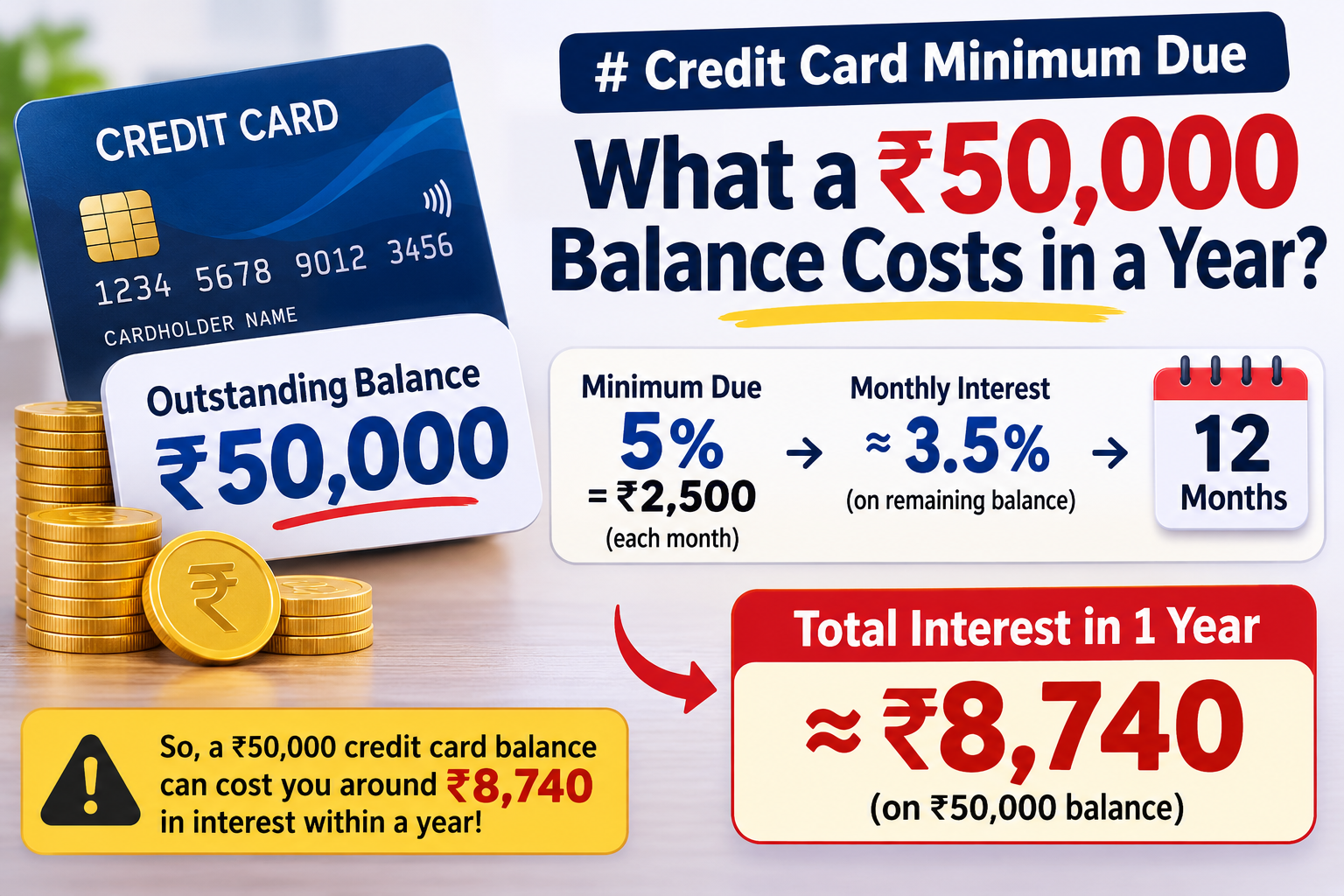
There's a question that most credit card holders in India have probably never paused to answer honestly. If you're carrying a ₹50,000 balance on your credit card right now — and making only the minimum payment every month — do you actually know what that habit is costing you?
For most people, the answer is no. And the uncomfortable part is that credit card companies are quite aware of this.
After spending years working with personal finance content and helping readers understand how debt compounds over time, the minimum due trap is one of the patterns I keep coming back to. Not because it's complicated — it isn't — but because it's quietly damaging in a way that doesn't feel obvious month to month.
Here's a snapshot of what the numbers reveal: paying only the minimum due on a ₹50,000 balance, at a typical example rate of 3% per month (36% per annum), will cost you approximately ₹15,818 in interest in just one year. After 12 monthly payments totaling ₹27,496, you'd still owe around ₹38,522.
In this article, I'll walk you through the full math, explain how Indian banks structure these payments, and share practical strategies that can genuinely help you break this cycle.
📌 Important Disclaimer: This article is intended for educational and informational purposes only. The calculations here use 3% monthly interest (36% per annum) as a typical illustrative rate. Actual interest rates on credit cards vary significantly by bank, card type, and individual account terms — and are often higher. Please check your own credit card statement or contact your bank for accurate figures applicable to your account. Nothing in this article constitutes personalised financial advice. For decisions specific to your financial situation, please consult a qualified financial advisor.
What Is the Credit Card Minimum Due?
The minimum due is the smallest payment your credit card issuer requires you to make each billing cycle to keep your account in good standing. Pay this amount on time and you avoid late payment charges, your account stays active, and no negative entry is recorded on your credit report.
That sounds like a reasonable safety net, doesn't it? Here's the part that catches most cardholders off-guard: the moment you don't pay your full outstanding balance, your entire remaining amount typically starts attracting interest from the very first day of that billing cycle. The interest-free grace period that makes credit cards so attractive in the first place disappears the moment you choose to carry a balance forward.
The minimum due is intentionally set at a level that feels manageable. It removes the urgency to act. It creates a surface-level sense of financial responsibility — you're paying on time, after all. But the minimum is structured so that the bulk of what you owe stays on the books, earning interest for the bank month after month.
In my experience researching and writing about personal finance, the people most affected by this pattern are often those who are genuinely careful about their bills. They never miss a due date, they always pay the minimum, and they feel like they're managing things responsibly. The monthly math says otherwise.
How Indian Banks Calculate Minimum Due
Most major Indian credit card issuers — including HDFC Bank, SBI Card, ICICI Bank, Axis Bank, and Kotak Mahindra Bank — follow a broadly similar structure:
- 5% of the total outstanding balance (or ₹200, whichever is higher)
- Any EMI instalments due in the current cycle are typically included
- Overdue amounts, over-limit charges, and applicable GST may also be added
About the interest rate used in this article:
For all calculations here, I've used a monthly interest rate of 3% (equivalent to 36% per annum). This is a commonly cited benchmark that falls within the range many Indian banks charge on revolving credit card balances. However, actual rates can range from approximately 24% to 48% per annum or more, depending on your bank, card type, and credit profile. Always check your statement or cardholder agreement for your specific rate — your actual costs could be meaningfully different from the figures shown here.
Month-by-Month Breakdown: ₹50,000 Balance
This is the section most people scroll past. It's also the most important one.
Assumptions used:
- Starting balance: ₹50,000
- Monthly interest rate: 3% (36% p.a. — illustrative example)
- Minimum payment: 5% of outstanding balance
Here's what 12 months of minimum-only payments looks like in practice:
Month 1: Balance ₹50,000 → Interest ₹1,500 → Payment ₹2,575 → Closing balance ₹48,925
Month 2: Balance ₹48,925 → Interest ₹1,468 → Payment ₹2,520 → Closing balance ₹47,873
Month 3: Balance ₹47,873 → Interest ₹1,436 → Payment ₹2,465 → Closing balance ₹46,844
Month 4: Balance ₹46,844 → Interest ₹1,405 → Payment ₹2,412 → Closing balance ₹45,837
Month 5: Balance ₹45,837 → Interest ₹1,375 → Payment ₹2,361 → Closing balance ₹44,851
Month 6: Balance ₹44,851 → Interest ₹1,346 → Payment ₹2,310 → Closing balance ₹43,887
Month 7: Balance ₹43,887 → Interest ₹1,317 → Payment ₹2,260 → Closing balance ₹42,944
Month 8: Balance ₹42,944 → Interest ₹1,288 → Payment ₹2,212 → Closing balance ₹42,020
Month 9: Balance ₹42,020 → Interest ₹1,261 → Payment ₹2,164 → Closing balance ₹41,117
Month 10: Balance ₹41,117 → Interest ₹1,234 → Payment ₹2,118 → Closing balance ₹40,233
Month 11: Balance ₹40,233 → Interest ₹1,207 → Payment ₹2,072 → Closing balance ₹39,368
Month 12: Balance ₹39,368 → Interest ₹1,181 → Payment ₹2,027 → Closing balance ₹38,522
Twelve months. Twelve on-time payments. And you'd still owe ₹38,522 — over 77% of what you started with. That's the quiet reality of minimum-only payments.
Total Interest Paid in One Year
Adding up every monthly interest charge across all 12 months:
₹1,500 + ₹1,468 + ₹1,436 + ₹1,405 + ₹1,375 + ₹1,346 + ₹1,317 + ₹1,288 + ₹1,261 + ₹1,234 + ₹1,207 + ₹1,181 = ₹15,818 in total interest
Your total payments across 12 months: ₹27,496
Of that amount, only ₹11,478 went toward reducing your actual principal. The remaining ₹15,818 went straight to the bank as interest income — on a balance of ₹50,000 that still stands at ₹38,522.
You paid over ₹27,000, diligently and on time, and barely moved the needle. That's not a scare tactic — it's the straightforward mathematics of revolving credit.
Remember: these numbers are based on the illustrative 3% monthly rate. If your bank charges a higher rate — which is common — your interest costs will be proportionally greater.
Why Banks Structure Payments This Way
It's worth understanding why minimum payments are structured the way they are. Banks are businesses, and revolving credit card balances are commercially significant products.
A cardholder who clears the full balance every month uses the credit card as a free short-term facility — no revolving interest is earned from them. A cardholder who pays only the minimum generates predictable, recurring interest income. At 36% per annum, that's a meaningful revenue stream.
Here's how the minimum payment structure works in practice — and why it typically favours the lender over time:
- It keeps accounts current. From the bank's perspective, a customer paying on time is low-risk. From yours, it feels like you're managing the debt well.
- It reduces urgency to pay more. When the minimum is small and affordable, the debt doesn't feel pressing — which often means it goes unaddressed.
- It extends the duration of the lending relationship. The longer the balance remains, the more interest accumulates on both sides of the ledger.
None of this is hidden or improper — it's disclosed in every cardholder agreement. What's missing for most people is a clear, practical understanding of what these terms translate to in actual rupees across actual months.
How Long Will It Actually Take to Clear This Debt?
Based on the same assumptions — 3% monthly interest, 5% minimum payment, no new charges added — continuing this pattern would take approximately 15 to 20 years to fully clear a ₹50,000 balance.
The reason it stretches so long is structural. Because the minimum payment is calculated as a percentage of the balance, it shrinks as the balance shrinks. Each month, you're paying just slightly more than the interest charge itself. The net principal reduction per month is roughly 2% of the balance — a figure that gets smaller in absolute terms every single month.
Across the full repayment period, the total interest paid under this scenario could reach ₹60,000 to ₹80,000 or more — meaning you'd potentially pay two to three times the original ₹50,000 in interest alone over the life of the debt.
These are estimates based on the illustrative rate used throughout this article. With a higher interest rate, or any additional spending on the card, the timeline and total cost would be greater.
When Minimum Payments Are Actually Acceptable
To be fair — there are real, legitimate situations where paying only the minimum due is the right short-term call.
If you're going through a genuine cash crunch — a medical emergency, a job transition, or an unexpected large expense — staying current on your account is far better than missing payments and triggering late fees or negative credit reporting.
Paying only the minimum can make practical sense temporarily if:
- You need a few months of breathing room while managing a more urgent financial obligation
- You're expecting a lump sum that will allow you to clear the balance entirely within a short window
- You have a specific, written plan to settle the balance within 60 to 90 days
The operative word is temporary. The minimum payment is an emergency lever — not a repayment strategy. If you've been paying only the minimum for more than three consecutive months without a clear path to clearing the balance, that's a signal worth acting on.
Smart Strategies to Break Free from the Minimum Due Trap
Here are approaches that tend to make a genuine, measurable difference:
1. Pay more than the minimum — even a little more helps. Raising your monthly payment from ₹2,500 to ₹5,000 on a ₹50,000 balance can shorten your repayment from many years to roughly 12–14 months, with proportional interest savings.
2. Try the debt avalanche method. List all your outstanding debts by interest rate. Direct every available extra rupee toward the highest-interest balance while maintaining minimums on others. Credit card debt almost always sits at the top of that list.
3. Explore balance transfer options. Several Indian banks offer balance transfer facilities at reduced or 0% promotional rates for 6–12 months. If you qualify, that window is a real opportunity — but it requires a disciplined plan to attack the principal before the promotional period ends and standard rates resume.
4. Consider converting to a personal loan. A personal loan at 12–18% per annum versus a credit card's 36%+ can meaningfully reduce your monthly interest cost and gives you a fixed, predictable repayment schedule. Compare the total cost carefully before switching.
5. Stop adding new charges while repaying. You can't empty a bucket with the tap running. If you're focused on clearing a balance, adding new purchases to the same card sets you back every month.
6. Set up automated higher payments. Use your bank's standing instruction feature to schedule a fixed, higher payment automatically. This removes the temptation to revert to the minimum during months when cash flow feels tighter.
Warning Signs You May Be Stuck in the Cycle
Sometimes the pattern isn't obvious from month to month. Here are some signals worth noticing:
- Your credit card balance barely decreases despite making every payment on time
- The monthly interest charge on your statement is approaching or exceeding the minimum due itself
- You're using one card for daily expenses while paying only the minimum on another
- You can't remember the last time your credit card balance was at zero
- Opening your monthly statement generates a low-level sense of unease
If two or more of these feel familiar, it may be worth reviewing your situation more closely and forming a more intentional repayment plan.
One pattern I've noticed fairly consistently is that people delay action because of embarrassment or the vague hope that things will naturally improve with time. A ₹50,000 balance at 36% annual interest doesn't improve on its own — it compounds. Getting into this situation is common, the product is designed to make it easy, but staying in it longer than necessary is a choice — and so is deciding to change course.
Conclusion: The Real Cost — and What to Do Next
Here's the full picture of what a ₹50,000 credit card balance can cost under minimum-only payments over one year (based on the illustrative 3% monthly rate):
- Approximately ₹15,818 in total interest charged across 12 months
- ₹27,496 in total payments made diligently and on time
- ₹38,522 still owed at the end of year one — over 77% of the original balance
- Potentially 15 to 20 years to fully clear the balance on minimum payments alone
- Potentially ₹60,000 to ₹80,000+ in total interest paid over the full repayment period
The minimum due isn't built to help you exit debt quickly. It's the smallest number that keeps you current — while interest continues to compound on everything that remains.
Here's one practical first step: open your most recent credit card statement. Find the interest charge line. Find how much of your minimum payment reduced your actual principal balance. Then ask yourself honestly whether that repayment pace is one you're comfortable with.
You now have the numbers, the context, and several concrete strategies. What you do with that information is entirely up to you.
📌 All calculations in this article are based on a 3% monthly (36% p.a.) illustrative example rate. Your actual rate may differ. Please refer to your cardholder agreement or contact your bank for the exact figures applicable to your account. This content is for educational purposes only and does not constitute financial advice.
Frequently Asked Questions (FAQs)
1. What actually happens if I keep paying only the minimum due on my credit card?
Paying on time each month keeps your account in good standing and helps you avoid late payment charges. However, interest continues to compound on the full remaining balance. Over time — especially at the rates typically charged on credit cards in India — the total cost of the debt grows significantly, and paying off the balance with minimum payments alone can take far longer than most cardholders realise.
2. What percentage of my balance is typically set as the minimum due in India?
Most Indian banks set the minimum due at 5% of your total outstanding balance or ₹200, whichever is higher. Some banks may also include EMI amounts due in the current cycle, applicable GST, or overdue charges in the minimum figure. Check your cardholder agreement for the exact formula your bank uses.
3. Does paying only the minimum due hurt my credit score?
Paying on time — even if it's only the minimum — avoids a late payment mark and doesn't directly damage your credit score in the short term. However, carrying a consistently high credit utilisation ratio over an extended period can gradually reduce your score, since utilisation is a significant scoring factor at India's credit bureaus.
4. How much interest would I pay on a ₹50,000 balance over one year?
Based on a 3% monthly interest rate (36% p.a.) — a commonly used illustrative rate — and paying only the minimum due, you'd pay approximately ₹15,818 in interest over 12 months, with your balance reducing from ₹50,000 to roughly ₹38,522. These figures will vary based on your actual interest rate.
5. Is a balance transfer a sensible option for clearing credit card debt in India?
It can be, depending on the terms. Promotional balance transfer offers at 0% or low interest for a limited period (typically 6–12 months) can significantly reduce interest costs — provided you have a realistic plan to clear the transferred balance before the promotional rate expires. Always check processing fees and the standard rate that applies afterward before making a decision.
6. What's the most practical way to pay off ₹50,000 in credit card debt?
The most effective approach is generally to pay as much above the minimum as your budget allows, avoid adding new charges to the card while repaying, and explore options like a balance transfer or converting to a lower-interest personal loan if the numbers make sense for your situation. Even modest increases in monthly payments above the minimum can meaningfully reduce your repayment timeline and total interest costs.
7. What is the difference between minimum amount due and total amount due on my statement?
The total amount due is your complete outstanding balance — including principal, accrued interest, and any applicable fees. The minimum amount due is the smallest payment required to keep your account in good standing for that billing cycle. Paying the total amount due in full every cycle means you pay zero revolving interest. Paying only the minimum means interest begins accumulating on everything that remains unpaid.