Disclaimer: This article is for educational and informational purposes only and does not constitute financial advice or investment recommendations. Mutual fund investments involve market risk, including the possible loss of principal. Always consult a licensed, SEC-registered financial advisor before making any investment decisions.
Introduction: Two Numbers, Two Very Different Stories
Most mutual fund investors in the United States have seen a CAGR figure at some point. It's on fund fact sheets, investment app dashboards, Morningstar pages, and practically every piece of fund marketing material you'll ever come across.
But here's something that trips up even experienced investors. That number as accurate as it is might have absolutely nothing to do with what your money actually earned.
This is where Money-Weighted Return, also known as IRR or Internal Rate of Return, enters the picture. And once you understand the difference between these two metrics, the way you evaluate your mutual fund investments will never be quite the same.
This article breaks down both metrics honestly and practically what they measure, where each one belongs, and which one actually matters more for your specific situation as a regular investor.
What Is CAGR and What Does It Actually Measure?
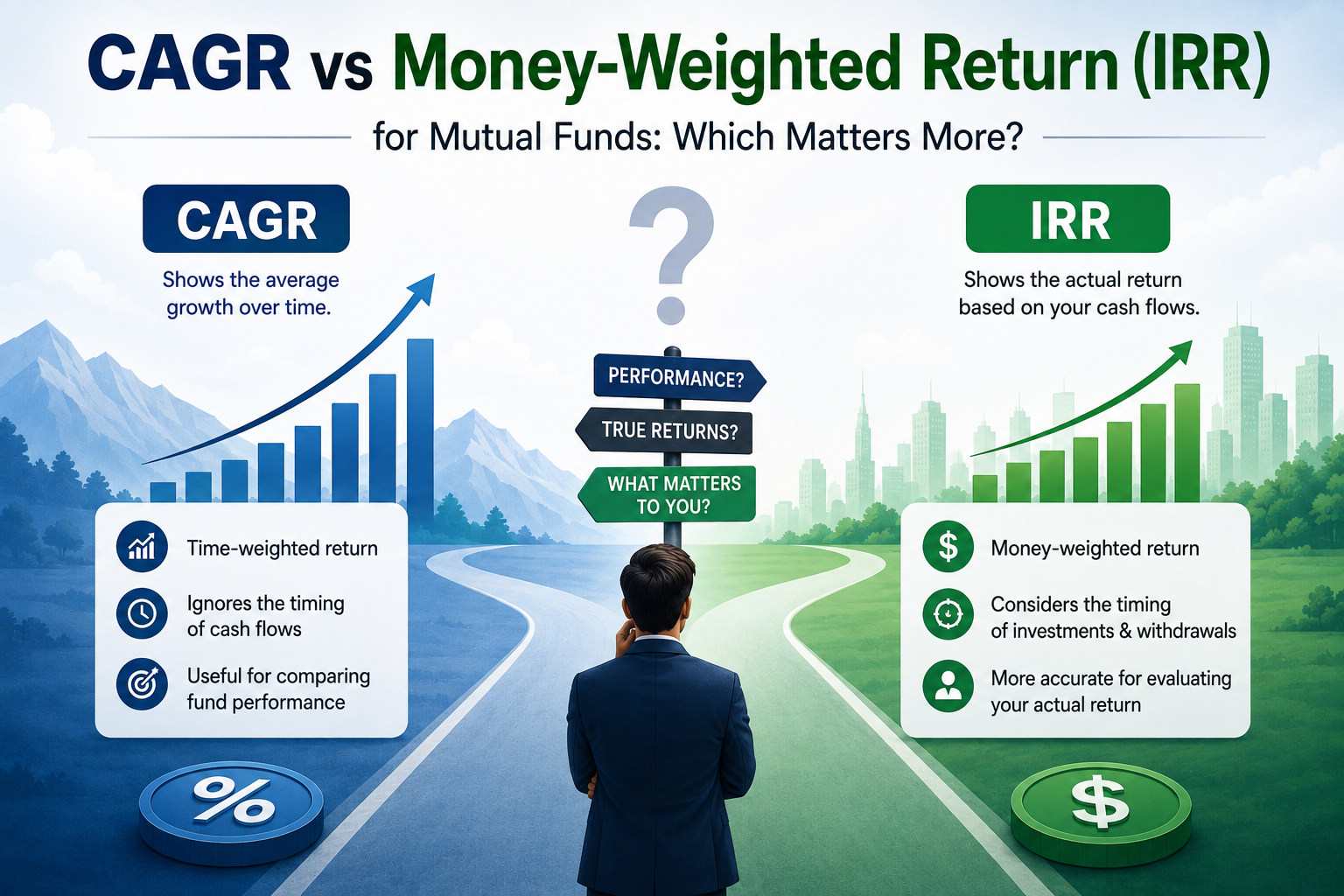
CAGR stands for Compound Annual Growth Rate. At its core, it answers one specific question: if you had invested a single lump sum at the beginning of a period and left it completely untouched, how much would it have grown each year on average?
The formula smooths out the volatility of individual years and gives you one clean, comparable percentage. A fund that returned 30% one year, lost 10% the next, and gained 15% the year after might show a CAGR of around 11% a number that represents none of those individual years but gives you a useful average for comparison purposes.
Why CAGR is useful:
- It creates a level playing field when comparing two or more funds over the same period
- It allows you to benchmark a fund against the S&P 500, Russell 2000, or any other index
- It's the standardized figure used in SEC-required fund disclosures and on platforms like Morningstar, Fidelity, and Vanguard
- It's simple to calculate and easy to understand at a glance
Where CAGR falls short:
Here's the limitation that most fund companies don't highlight in their advertising. CAGR is calculated on a hypothetical lump sum invested at the start of the measurement period. It assumes every dollar you own was in the fund from day one. It has no mechanism to account for contributions you made at different times, withdrawals you took, or the varying amounts you invested month to month.
For a single lump-sum investor who bought and held, CAGR is accurate. For everyone else which is most people it's telling a story that doesn't quite match reality.
What Is Money-Weighted Return (IRR)?
Money-Weighted Return, or MWR, is the same calculation as Internal Rate of Return applied to an investment portfolio. In spreadsheet software, you'll see it called XIRR. On brokerage platforms like Fidelity, Schwab, or Vanguard, it often appears simply as "Personal Rate of Return" or "Money-Weighted Return" in your account performance section.
The key difference from CAGR is this: Money-Weighted Return accounts for the exact timing and size of every dollar that moved in and out of your investment. Every monthly contribution. Every dividend reinvestment. Every partial withdrawal. Every lump-sum top-up. All of it.
It answers the question CAGR never asks: given exactly when you put your money in and when you took it out, what annualized return did your actual dollars earn?
That is your real return. Not a hypothetical. Not an idealized scenario. Your money, your timeline, your result.
Why Money-Weighted Return matters:
- It reflects your personal experience as an investor
- It captures the impact of your contribution and withdrawal timing
- It accounts for whether you invested more during market highs or market lows
- It is the figure fee-only financial advisors registered with NAPFA use when reviewing actual client portfolio performance
The Core Difference: A Straightforward Way to Think About It
Imagine two different rulers. One ruler measures the length of a road from one fixed end to another. That's CAGR a clean measurement between two fixed points assuming everything stayed in one place.
The second ruler measures the journey you actually took with detours, stops along the way, extra miles added, and some sections backtracked. That's Money-Weighted Return it traces what your actual dollars experienced.
Both rulers are accurate. They're just measuring different things. The mistake investors make is grabbing the first ruler when they should be using the second one to evaluate their own results.
A Realistic Example That Shows the Gap Clearly
Let's look at two investors both using the same mutual fund, over the same five-year period from 2019 to 2024. The fund's advertised five-year CAGR is 12%.
Investor One Lump Sum:
Carol invested $25,000 in January 2019 and never made another contribution or withdrawal. Five years later, her investment is worth approximately $44,100. Her personal return closely mirrors the advertised 12% CAGR. For Carol, that number is accurate and fair.
Investor Two Regular Contributions:
Brian set up $500 monthly automatic contributions starting in January 2019. The fund dropped roughly 28% during the market selloff in early 2020. Brian didn't panic. He kept his automatic contributions running without interruption.
Because he kept investing through the downturn, Brian purchased a significant number of fund units at depressed prices throughout 2020. When the market recovered strongly in 2021, those cheaply acquired units appreciated substantially. Brian calculated his Money-Weighted Return using the XIRR function in Google Sheets and found his actual annualized return was approximately 14.3% more than two percentage points above the advertised CAGR.
His discipline during the worst of the downturn became the single biggest contributor to his outperformance relative to the CAGR figure.
Now consider a third scenario:
Suppose the same fund had delivered strong performance from 2019 to 2021 but then struggled from 2022 through 2024. An investor who increased their monthly contributions significantly in 2022 and 2023 right before the underperformance period would have put their largest dollars to work at the worst time. Their Money-Weighted Return might come in closer to 9% or 10%, meaningfully below the fund's 12% CAGR.
Same fund. Same advertised return. Three very different personal outcomes because the timing of each investor's cash flows was different.
Which One Matters More? The Honest Answer
The direct answer is: it depends entirely on how you invest.
If you are a lump-sum investor you moved a significant amount of money into a fund once and have held it since CAGR accurately represents your experience. It's the right number to evaluate.
If you are a regular, recurring investor contributing monthly through an automatic investment plan, employer-sponsored retirement account, IRA, or any similar structure Money-Weighted Return is the only metric that reflects what your dollars actually earned. CAGR, in that context, describes a scenario that didn't happen to you.
For most American mutual fund investors, the answer is Money-Weighted Return. The majority of retail investors in the US contribute regularly rather than investing lump sums, which means the vast majority of investors are looking at the wrong number when they read an advertised CAGR and assume it reflects their personal result.
This isn't about one metric being better or more accurate in an absolute sense. It's about using the right tool for your specific situation.
When Each Metric Belongs in Your Analysis
Use CAGR when:
- Comparing two or more funds' historical performance over the same time window
- You made a single lump-sum investment and have not added or withdrawn since
- Benchmarking a fund's performance against the S&P 500, a bond index, or any other reference
- Reading standardized disclosures on Morningstar, SEC filings, or fund prospectuses
- Screening funds as part of your initial research process
Use Money-Weighted Return when:
- You invest on a monthly, quarterly, or any recurring schedule
- Your investment history includes contributions of varying sizes at different times
- You've made withdrawals, partial redemptions, or lump-sum additions at any point
- You want to evaluate whether your personal investment strategy is actually meeting your financial goals
- You're reviewing your portfolio performance with a financial advisor
- You want to compare your real return against a target you've set in your financial plan
How to Find Your Money-Weighted Return Right Now
You have two straightforward options, and neither requires any specialized software.
Option 1 Check your brokerage dashboard:
Fidelity, Vanguard, Schwab, and most major US brokerage platforms already calculate your personal Money-Weighted Return and display it in your account performance section. Look for labels like "Personal Rate of Return," "Money-Weighted Return," or "Dollar-Weighted Return." These are all the same calculation, just named differently across platforms.
Option 2 Calculate it yourself in Excel or Google Sheets:
- Open a spreadsheet and create two columns: Date and Cash Flow
- Enter each contribution date with the amount as a negative number (money leaving your wallet)
- On the final row, enter today's date and your current portfolio value as a positive number
- In an empty cell, enter the formula: =XIRR(B2:B100, A2:A100) adjusting the range to match your data
- The result, multiplied by 100, is your annualized Money-Weighted Return as a percentage
Your brokerage allows you to export your full transaction history as a CSV file. Download it, paste it into your spreadsheet, and the formula does the rest in seconds.
What a Meaningful Gap Between the Two Numbers Tells You
Once you have both numbers the fund's advertised CAGR and your personal Money-Weighted Return the gap between them is genuinely informative.
If your MWR is significantly higher than the CAGR: You likely contributed more during periods when the market was down, buying units cheaply before the recovery. Your timing, intentional or not, worked in your favor.
If your MWR closely matches the CAGR: Your contributions were fairly evenly distributed across market conditions, or you made a lump-sum investment and held it. Either way, you captured roughly what the fund delivered.
If your MWR is significantly lower than the CAGR: Your largest contributions may have coincided with market peaks, or you withdrew funds during downturns and missed the recovery. This is the most common outcome for investors who try to time the market increasing contributions during rallies and pausing during selloffs.
Understanding this gap doesn't require any action by itself. But it gives you an honest starting point for evaluating whether your current investment approach is working the way you expect.
Red Flags Worth Knowing When Reading Fund Return Data
A few patterns appear repeatedly in how mutual fund performance is presented, and they're worth recognizing:
- CAGR used to describe systematic investment results technically inaccurate; recurring investments require Money-Weighted Return for a fair representation
- "Since inception" CAGR without a benchmark if a fund launched right before a sustained bull market, inception-date CAGR can look deceptively impressive
- Absolute returns presented without annualizing "100% return over eight years" sounds exceptional until you annualize it, which reveals roughly 9% per year
- Single time-window performance emphasized a fund can look strong over three years and mediocre over ten; always check multiple periods
- High returns presented without any risk context a fund that returned 18% annually through heavy concentration in one sector carries very different risk than a diversified fund returning 13%
The SEC's investor education platform at Investor.gov covers mutual fund disclosures in plain language and explains exactly what fund companies are legally required to show you. It's a genuinely useful resource.
Conclusion: The Number That Belongs to You
CAGR is a valuable tool. It's standardized, comparable, and essential for evaluating fund performance on a level playing field. Use it when screening funds, comparing historical records, and reading prospectuses.
But Money-Weighted Return is the number that actually belongs to you. It's calculated on your money, your timeline, and your specific investment behavior. For anyone who invests regularly monthly contributions, automatic reinvestment, recurring additions of any kind it is the only figure that honestly reflects what your dollars earned.
This week, take ten minutes to find your personal Money-Weighted Return. Check your brokerage dashboard or run the XIRR calculation yourself. Compare it to the CAGR the fund advertises. That gap however large or small is the difference between the fund's story and yours.
Knowing your actual number is not about judgment. It's about clarity. And clarity is the foundation of every good financial decision.
Disclaimer: This article is for general educational purposes only and does not constitute personalized financial, tax, or investment advice. All examples are illustrative and hypothetical. Past performance of any investment does not guarantee future results. Mutual fund investments involve risk, including possible loss of principal. Please consult a qualified, SEC-registered financial professional before making investment decisions.
Frequently Asked Questions
1. Is Money-Weighted Return the same thing as IRR?
Yes. Money-Weighted Return and Internal Rate of Return (IRR) are the same calculation applied to an investment portfolio. In spreadsheet software, this function is called XIRR. On brokerage platforms, it may appear as "Personal Rate of Return" or "Dollar-Weighted Return." All of these terms refer to the same underlying calculation your annualized return adjusted for the timing and size of every cash flow.
2. Which metric do financial advisors typically use when reviewing client portfolios?
Fee-only financial advisors, particularly those affiliated with NAPFA (National Association of Personal Financial Advisors) or holding the CFP designation, generally use Money-Weighted Return when evaluating a client's actual investment performance. CAGR is used for fund-level comparison and benchmarking. When your advisor reviews what your money earned, they should be showing you MWR, not CAGR.
3. My brokerage shows a "Personal Rate of Return" is that the same as Money-Weighted Return?
Yes, in most cases. Fidelity, Vanguard, Schwab, and most major US brokerages calculate Personal Rate of Return using the money-weighted methodology meaning it accounts for the timing and size of your contributions and withdrawals. It is effectively the same as XIRR. Check your platform's methodology disclosure if you want to confirm how they define it.
4. Can my Money-Weighted Return be higher than the fund's advertised CAGR?
Absolutely, and it happens regularly. If you invested consistently during a market downturn and the fund subsequently recovered, you purchased units at lower prices. When those units appreciated, your return on invested capital exceeded what a hypothetical lump-sum investor would have earned from the beginning. The reverse is equally possible large contributions right before a prolonged downturn can pull your MWR well below the CAGR.
5. Does it matter which time period I use when comparing CAGR across funds?
Yes, significantly. A fund might show a strong three-year CAGR but a mediocre ten-year CAGR, depending on which market cycles fall within each window. Always compare funds over multiple time periods one, three, five, and ten years at minimum before drawing any conclusions. Morningstar and the SEC's EDGAR database both provide multi-period CAGR data for registered mutual funds.
6. How often should I calculate my Money-Weighted Return?
At minimum, once a year during your annual portfolio review. If you're working toward a specific financial goal retirement, a home purchase, or education funding checking your MWR twice a year helps you assess whether you're on track relative to your plan. More frequent checks aren't necessary and can encourage reactive decision-making based on short-term fluctuations.
7. What's a reasonable Money-Weighted Return expectation for a US equity mutual fund?
Historical data shows that broadly diversified US equity funds have delivered average annual returns roughly in the 7% to 10% range over long periods, though this varies considerably by fund type, market conditions, and time period. Your individual MWR will depend on which fund you chose, your contribution timing, and how long you've been invested. These figures are general historical context, not projections or guarantees.
8. If my MWR is much lower than the fund's CAGR, does that mean I should switch funds?
Not necessarily. A gap between your MWR and the fund's CAGR doesn't indicate a problem with the fund it reflects the timing of your personal cash flows. Before switching funds based on this comparison, evaluate whether your contribution pattern, not the fund's management, is the primary cause. Consulting a fee-only advisor can help you interpret this gap in the context of your overall financial plan.
9. Are there situations where neither CAGR nor Money-Weighted Return gives me the full picture?
Yes. Both metrics measure return without directly accounting for risk. A fund might deliver a high MWR in a specific period through concentrated sector bets or high volatility and that level of risk may not be appropriate for your situation. Always review risk metrics alongside return figures, including standard deviation, maximum drawdown, and Sharpe ratio, which are available on Morningstar for any registered mutual fund.
10. Where can I learn more about how mutual fund returns are calculated and disclosed?
Investor.gov, operated by the SEC, is the most reliable free resource for US investors. It covers how mutual fund returns are required to be presented, what fund prospectuses must include, and how to read performance data critically. Morningstar's free research tools and FINRA's investor education center are also excellent resources for understanding fund metrics, risk measurements, and disclosure requirements.