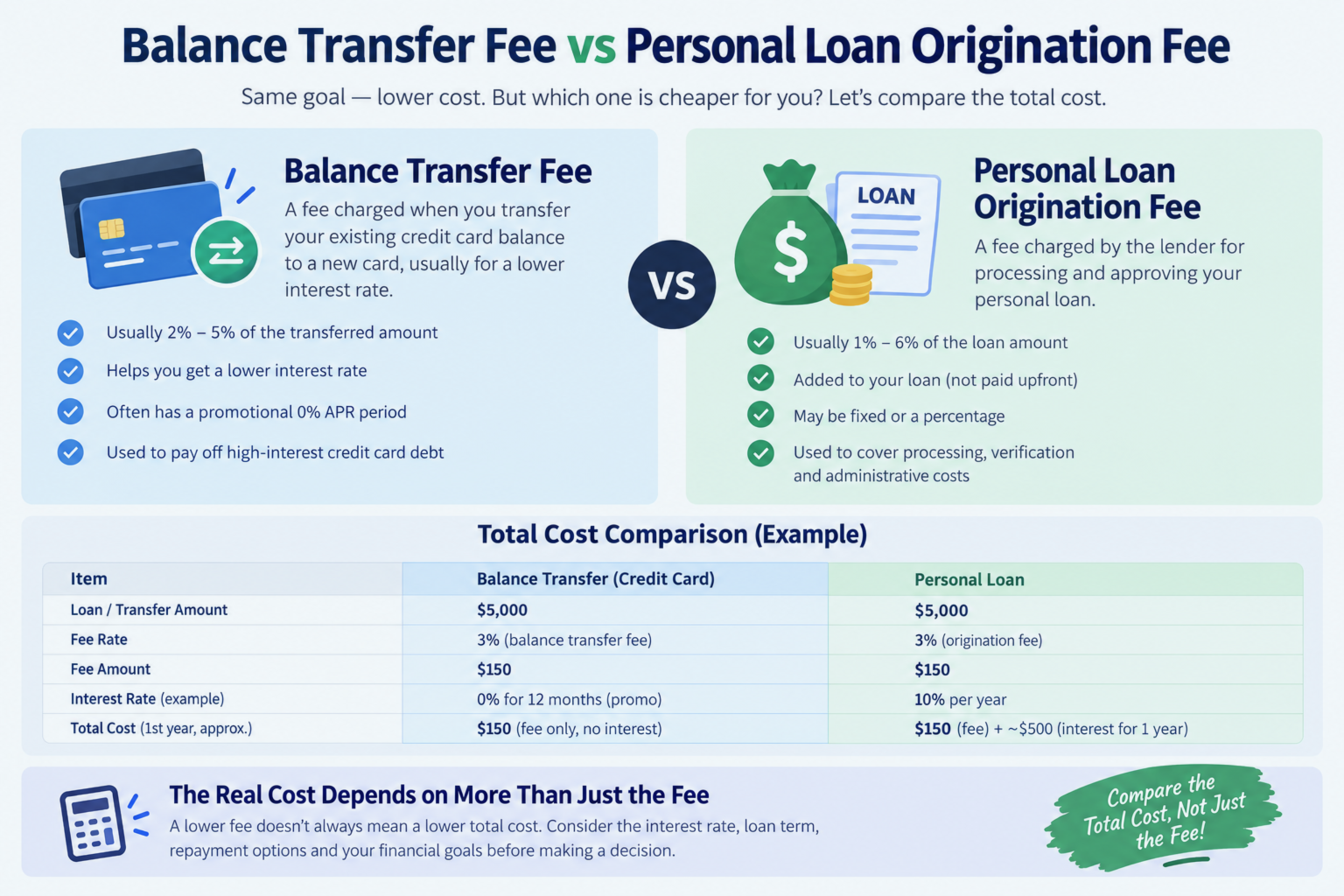
When you're buried in high-interest credit card debt, two escape routes tend to pop up fast: a balance transfer credit card or a personal loan. Both can genuinely help you pay off debt faster and save real money on interest. But here's the thing most people overlook both options come with upfront fees that can quietly chip away at your savings before you even get started.
I've spent years helping people navigate debt payoff strategies, and one of the most common questions I get is this: "Which option is actually cheaper once you count all the fees?" It's a smart question. And honestly, the answer isn't as obvious as most people expect.
A balance transfer fee and a personal loan origination fee might look minor on paper. But depending on how much debt you're moving and what terms you're working with, those fees can make or break your decision. Choosing the wrong option could cost you hundreds of dollars sometimes more.
In this article, we're going to break down exactly what each fee is, how it's calculated, and most importantly, which one costs you less in the long run. By the end, you'll have a clear picture to make a confident, money-smart decision.
Table of Contents
- What Is a Balance Transfer Fee?
- What Is a Personal Loan Origination Fee?
- How Each Fee Is Calculated
- Real-World Cost Comparison
- When a Balance Transfer Is the Better Deal
- When a Personal Loan Saves You More Money
- Hidden Costs You Might Be Overlooking
- Practical Tips to Reduce What You Pay
- Conclusion
- Frequently Asked Questions
What Is a Balance Transfer Fee?
A balance transfer fee is the charge you pay when you move existing credit card debt onto a new card -typically one offering a 0% introductory APR. It's essentially the cost of accessing that interest-free promotional window.
Most balance transfer fees fall between 3% and 5% of the total amount you're transferring. Some cards also set a flat minimum, usually around $5 to $10, and you pay whichever amount is greater.
So if you transfer $8,000 in credit card debt to a new card with a 3% balance transfer fee, you're paying $240 upfront. At 5%, that jumps to $400. That fee gets added directly to your new balance, not billed separately.
If that new card offers 0% APR for 15 to 21 months, that upfront charge can feel totally worth it -and often, it genuinely is. But a few things can complicate the picture quickly.
The Promotional Period Matters More Than You Think
One thing I've noticed after working through countless debt scenarios is that people focus way too much on the 0% rate and not nearly enough on what happens once the promotional window closes. Once that intro period ends, most balance transfer cards jump to a regular APR somewhere between 19% and 28%.
If you haven't paid off the transferred balance by then, you're back in high-interest territory -sometimes worse than where you started. That's why the balance transfer fee is just one piece of the true cost equation.
What Is a Personal Loan Origination Fee?
A personal loan origination fee is what a lender charges for processing and funding your loan. Think of it as the administrative cost of getting access to a lump sum of money when you need it.
Origination fees on personal loans typically range from 1% to 8% of the total loan amount. Some lenders charge 0%, while others charge more for borrowers with lower credit scores.
Here's where it gets a little different from a balance transfer fee: origination fees are sometimes deducted directly from your loan disbursement rather than added to your balance. So if you borrow $10,000 and your origination fee is 5%, you receive $9,500 in your account but you still owe the full $10,000.
That distinction matters a lot when you're trying to run an accurate balance transfer vs personal loan total cost comparison.
Fixed Payments vs. Open-Ended Flexibility
One advantage personal loans hold over balance transfers is predictability. You get a fixed interest rate, a set monthly payment, and a defined payoff date. For people who struggle with open-ended debt or tempting available credit, that built-in structure makes a real difference.
I've personally found that people who don't fully trust themselves to aggressively pay down a balance transfer card before the promo window closes almost always come out better with a personal loan even when the origination fee is a touch higher.
How Each Fee Is Calculated
Let's get into the actual numbers, because this is where clarity usually kicks in and the decision becomes much easier to make.
Balance Transfer Fee Calculation
The formula is simple:
Transfer Amount × Fee Percentage = Fee You Pay
If you transfer $7,500 at a 3% fee, you pay $225. At 5%, that's $375. Your new starting balance becomes $7,725 or $7,875, depending on the rate your new card charges.
Personal Loan Origination Fee Calculation
Personal loan origination fees come in two forms and knowing the difference is crucial:
Added to your loan balance: You borrow $7,500, the lender tacks on a 5% fee of $375, and your total repayment amount is $7,875.
Deducted from your disbursement: You borrow $7,500, the lender keeps $375 as their fee, and you receive just $7,125 but you still repay the full $7,500.
The second version is the sneakier one. If you actually need $7,500 to clear your debt, you'll need to borrow more than $7,500 to cover the deducted fee -which means you'll also pay more in interest over the life of the loan.
Real-World Cost Comparison
Let's run through a concrete, realistic scenario. Suppose you have $10,000 in credit card debt at 22% APR and your goal is to pay it off in 18 months.
Option 1: Balance Transfer Card
- Transfer fee at 3%: $300 added to your balance
- New balance: $10,300
- Intro APR: 0% for 18 months
- Monthly payment needed: roughly $572
- Total amount repaid: $10,300
- Fee cost: $300
Option 2: Personal Loan
- Loan amount: $10,000
- Origination fee at 4%: $400 added to balance
- New loan total: $10,400
- Interest rate: 12% APR over 18 months
- Monthly payment: roughly $618
- Total interest paid: approximately $680
- Total amount repaid: $11,080
In this scenario, the balance transfer card saves you around $780 but only if you pay off the full balance before that 18 month window closes.
Now flip it. Say you can't quite finish in time and the card's regular APR kicks in at 25%. Whatever balance is left starts piling up fast. Suddenly that personal loan at a locked in 12% looks like the smarter choice all along. This is exactly why running the long-term numbers matters more than just comparing fees.
When a Balance Transfer Is the Better Deal
A balance transfer makes the most financial sense when:
- You have a clear, realistic plan to pay off the full balance within the promotional period
- The amount you're transferring is under $6,000 to $7,000, so the fee doesn't become a large dollar amount
- You find a card offering 0% balance transfer fees during a limited promotional window (they do exist)
- You're disciplined enough to avoid adding new purchases to the card while paying it down
- You want to steer clear of a longer-term loan commitment
Here's a practical example: if you find a card with 0% APR for 18 months and a 3% transfer fee, and you're moving $4,500, you'll pay just $135 to escape potentially several hundred dollars in interest charges. That's a genuinely excellent deal -as long as you commit to the payoff timeline and don't stray from it.
When a Personal Loan Saves You More Money
On the other side of the coin, a personal loan tends to be the smarter choice when:
- Your debt is large over $10,000 to $15,000 where even a 3% transfer fee becomes a sizeable upfront hit
- You need more than 18 to 21 months to reasonably pay off the balance
- You want guaranteed interest savings regardless of your payment speed
- You prefer the clarity and discipline of a fixed monthly payment
- You qualify for a low or zero origination fee through a credit union or competitive online lender
- You're consolidating multiple types of debt, not just credit card balances
In my experience, borrowers dealing with higher debt amounts or longer repayment horizons almost always benefit more from a personal loan, especially when they take the time to shop lenders and find competitive origination fees. The math simply works out better over longer timelines.
Hidden Costs You Might Be Overlooking
Here's where a lot of people get blindsided -both options carry additional costs that don't always appear in the headline fee.
For Balance Transfers:
- Annual fees on the new card some balance transfer cards charge $95 to $150 per year
- Late payment penalties that can void your 0% APR entirely, replacing it with a penalty rate
- Cash advance fees if you accidentally use the card for withdrawals
- Penalty APR that can spike as high as 29.99% after just one missed payment
For Personal Loans:
- Prepayment penalties if you decide to pay off the loan ahead of schedule
- Late payment fees, typically $25 to $50 per occurrence
- Variable interest rates on some loan products, meaning your payment could rise over time
- A temporary drop in your credit score from the hard inquiry and the addition of a new account
These often-overlooked expenses can significantly shift the math in ways that aren't obvious at the start. Always ask lenders directly about every possible fee before signing anything.
Practical Tips to Reduce What You Pay
For balance transfers:
- Search specifically for cards offering 0% or reduced transfer fees during limited promotional periods
- Only transfer an amount you're genuinely confident you can pay off within the intro window
- Set up automatic payments to protect your promotional APR from a single missed due date
- Avoid new purchases on the card -many issuers apply payments to new charges first, leaving your transferred balance sitting and accumulating interest later
For personal loans:
- Compare multiple lenders origination fees vary dramatically, anywhere from 0% to 8%
- Check credit unions before traditional banks they frequently offer lower fees and better rates
- Work on improving your credit score before applying even a 20 to 30 point improvement can meaningfully reduce your rate
- Never borrow more than you actually need every extra dollar costs you in fees and interest
- Ask directly about fee waivers some lenders, particularly smaller institutions, will negotiate with borrowers who have solid credit histories
Conclusion
At the end of the day, the balance transfer fee vs personal loan origination fee comparison doesn't have a single universal winner. They're both useful financial tools. The right one depends on your specific debt amount, your realistic repayment timeline, your credit score, and let's be completely honest your spending discipline.
If you're working with a manageable amount of debt and you're committed to paying it off within the promotional window, a balance transfer card with a low transfer fee can be an outstanding money-saver. But if you're staring down a larger balance or you need more time than a promo period allows, a personal loan with a modest origination fee often costs you less from start to finish.
The most important takeaway? Never just compare the headline fees. Run the full numbers every fee, every interest charge, every potential penalty -and compare what you'll actually pay in total.
Take action today: Grab a notepad or a simple spreadsheet and map out your own numbers using the examples in this article. Once you see the real total cost laid out side by side, the right choice for your situation will become much clearer. And if this breakdown helped you, share it with someone else who's stuck trying to figure out the same thing.
Frequently Asked Questions
1. Is a balance transfer fee worth
paying if the card offers 0% APR?
In most cases, yes but only if you can realistically pay off the full balance
before the promotional period ends. Even a 5% transfer fee is typically far
less than several months of 20%+ interest charges, provided you stick to the
payoff plan.
2. What's considered a good
origination fee on a personal loan?
Anything under 2% is excellent. Between 2% and 5% is average and generally
acceptable. Anything above 6% should push you to shop around further,
especially if your credit score is in decent shape.
3. Can you completely avoid balance
transfer fees?
Sometimes. A small number of credit card issuers offer 0% balance transfer fees
during limited promotional windows. These deals aren't common, but they're
absolutely worth searching for before assuming you'll pay 3% to 5% every time.
4. Which option is better for large
debts -say $15,000 or more?
For debts that size, a personal loan is almost always the more cost-effective
route. A 3% to 5% balance transfer fee on $15,000 comes to $450 to $750
upfront, and most people simply can't pay off that amount within a standard
18-month promotional window.
5. Does taking a personal loan hurt
your credit score?
Slightly, and temporarily. Applying creates a hard inquiry, and opening a new
account shortens your average account age. However, making consistent, on-time
payments rebuilds your score steadily over time and often improves it beyond
where it started.
6. What happens if I miss a payment
on a balance transfer card?
Depending on your card's terms, a single missed payment could trigger a late
fee, cancel your 0% APR, and activate a penalty rate -sometimes as high as
29.99%. Setting up automatic minimum payments is the simplest way to protect
yourself from this risk.
7. Are personal loan origination
fees ever negotiable?
Yes, in some situations. Borrowers with strong credit profiles have more
leverage to request a reduced or waived origination fee, particularly with
smaller lenders and credit unions. It never hurts to ask the question before
you sign on the dotted line.