Financial Disclaimer: This article is for informational and educational purposes only. It does not constitute professional financial advice. Everyone's financial situation is different please consult a certified financial planner or advisor before making major money decisions.
The Smartest Way to Use a 50/30/20 Budget Calculator to Pay Off Debt Faster
Nobody wakes up excited to budget. Let's be honest it feels like being put on a financial diet when you'd rather just eat the pizza. But here's what most people get wrong: a good budget isn't about restriction. It's about direction. And when you're trying to escape debt, direction is everything.
The 50/30/20 budget rule has been around for years, but I've watched people misuse it constantly either treating it like a rigid law or ignoring it the moment things get uncomfortable. When you actually apply it correctly, especially with the help of a 50/30/20 budget calculator, it becomes one of the clearest, most sustainable paths to paying off debt without completely burning out.
This article isn't going to sugarcoat anything. You'll get the real mechanics, the honest tradeoffs, and the specific adjustments that actually move the needle on debt payoff. Let's get into it.
What Is the 50/30/20 Budget Rule?
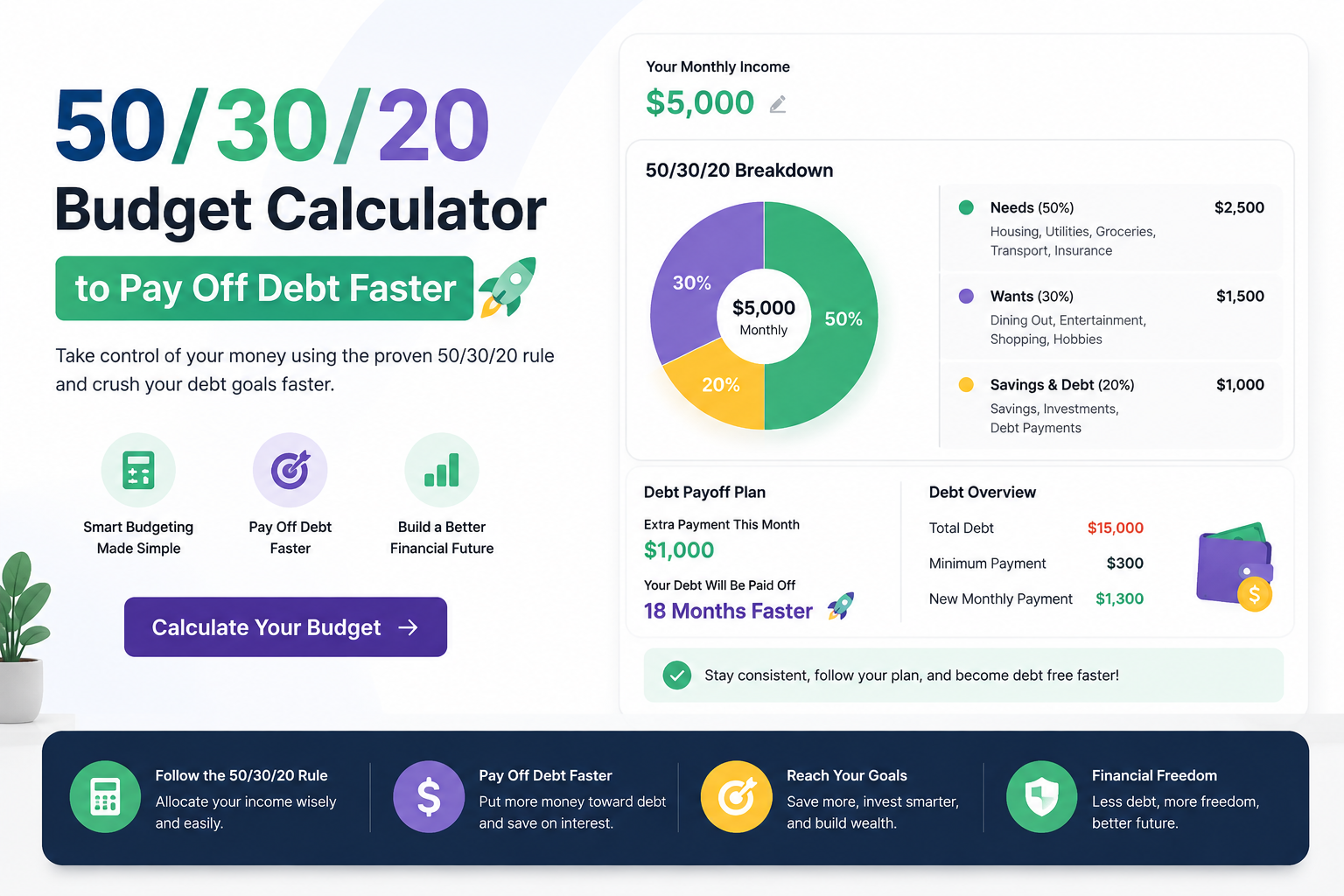
The 50/30/20 rule was popularized by Elizabeth Warren yes, the U.S. Senator in her book All Your Worth, co-written with her daughter. The core idea is dead simple: take your monthly after-tax income and divide it into three buckets.
- 50% for Needs rent or mortgage, groceries, utilities, minimum debt payments, transportation to work, insurance
- 30% for Wants dining out, streaming services, hobbies, shopping beyond basics, weekend trips
- 20% for Savings and Debt Repayment emergency fund, retirement contributions, and extra debt payments above the minimum
That's the whole framework. Three categories. No spreadsheet with 40 line items. No color-coded envelope system (unless that's your thing).
What makes it powerful isn't the math it's the clarity. Most people have a rough idea of their income but almost no idea how they're actually spending it. The 50/30/20 rule forces you to look at that honestly, often for the first time.
One thing worth understanding right away: the "needs" category includes your minimum debt payments. That matters. The extra debt payments the ones that actually chip away at the principal live in the 20% bucket. That distinction is where a lot of people get confused, and it's important to get it right.
How a 50/30/20 Budget Calculator Actually Works
A 50/30/20 budget calculator takes your monthly take-home income and automatically splits it into those three categories. Basic versions just show you the three numbers. More sophisticated debt payoff calculators go further they factor in your interest rates, current balances, and extra monthly payments to show you a projected debt-free date.
Here's what you'd typically enter:
- Monthly after-tax income
- Current monthly expenses (for comparison)
- Individual debt balances and their interest rates
The calculator then shows you two things that are genuinely useful: what your budget should look like, and how far off your current spending is from that target. That gap between where you are and where the rule says you should be is your starting point.
I've seen people log into a calculator expecting minor tweaks and realize they're spending 48% of their income on wants alone. That moment of clarity, uncomfortable as it is, tends to be more motivating than any advice article. The numbers don't lie, and they don't lecture you either.
For debt payoff specifically, look for calculators that let you model different scenarios like "what happens if I put an extra $200/month toward my credit card?" Being able to visualize your debt-free date moving from 2031 to 2028 is a surprisingly powerful motivator.
Why This Method Helps You Pay Off Debt Faster
Three reasons this works better than most people expect.
It protects your repayment money. When you earmark the 20% specifically for debt, it stops being "whatever's left at the end of the month" which, for most people, is nothing. Ring-fencing that money from the start means it actually gets used as intended.
It's sustainable enough to stick with. Aggressive debt payoff strategies that require you to cut everything and live on rice and beans tend to collapse around month three. The 50/30/20 rule keeps 30% available for the things you actually enjoy. That breathing room is what makes it workable long-term.
It simplifies decisions. Instead of debating every purchase, you already know the rules. Is this a need or a want? How much is left in my wants bucket this month? Simple questions with simple answers.
What it doesn't do is work automatically. You have to actually follow it, track it monthly, and be honest about which category things fall into. That part is on you.
Step-by-Step: Using the 50/30/20 Rule for Debt Payoff
Step 1: Start With Your Real Take-Home Income
Use your after-tax, after-deduction number the amount that actually hits your bank account. Not your salary. Not your gross pay. If your income varies month to month, average your last three months and use that figure.
Step 2: Run the Numbers Through a Calculator
Plug your monthly take-home into a 50/30/20 budget calculator. Write down the three dollar amounts it gives you. These are your targets, not suggestions.
Step 3: Track Two Months of Real Spending
Before you can fix your budget, you need to see it clearly. Pull up your last two bank and credit card statements. Categorize every single transaction needs, wants, or savings/debt. All of it. No rounding up groceries to cover a restaurant meal.
Step 4: Find the Gap
Compare your actual spending to your targets. Where are you over? Where are you under? For most people, the wants category is over and the savings/debt category is painfully under. That gap tells you exactly where to focus.
Step 5: Assign the 20% to Specific Debts
Don't just "put it toward debt" in a vague way. Decide right now which debt gets the extra payment. If you're using the debt avalanche method, that's your highest-interest debt. If you're using the snowball method, it's your smallest balance. Either approach works what matters is picking one and executing it every single month.
Step 6: Automate and Review Monthly
Set up automatic transfers so the 20% moves to debt repayment the same day your paycheck arrives. Then schedule a monthly 20-minute budget check-in to see how you're tracking and make adjustments.
Tweaking the Percentages When You're in Debt
The 50/30/20 rule was designed for general financial health, not specifically for aggressive debt payoff. When debt is your priority, the percentages should shift and that shift needs to be intentional, not random.
The most practical starting point is dropping your wants from 30% to 20% and pushing that extra 10% straight into debt repayment. On a $3,500/month take-home, that's $350 more going toward debt every single month. Over a year, that's $4,200 in extra principal payments before you even factor in the interest you're avoiding.
If your debt situation is more serious think multiple high-interest credit cards or a debt-to-income ratio that keeps you up at night consider going further. Pulling wants down to 15% and directing 35% toward debt is aggressive, but it's doable for short stretches. Most people can manage three to six months at that intensity before they need to ease up slightly.
For people living in expensive cities where rent alone chews through 40% or more of income, the needs category may realistically sit at 60%. In that case, work with a 60/15/25 split keep wants minimal and protect that 25% for debt. It's not perfect, but it's honest and workable.
The one thing I'd caution against is making the adjustment so steep that you can't sustain it. A wants budget cut from 30% to 20% that you maintain for two full years will always outperform a cut to 5% that collapses after six weeks. Consistency beats intensity here, every time.
The bottom line: treat the original percentages as a starting template. Move money from wants toward debt repayment based on how urgently you need to pay things off and revisit those numbers every month as your balances change.
Real-Life Example: Sarah's 26-Month Turnaround
Sarah is 29, works in marketing, and brings home $3,500 a month after taxes. She'd been "meaning to budget" for three years but kept putting it off. By the time she actually sat down and looked at her numbers, she had:
- $8,400 across two credit cards (one at 22.9% APR, one at 18.5%)
- $6,200 remaining on a personal loan at 11.3% APR
- A car payment of $310/month included in her needs
Her old spending breakdown: roughly $1,925 on needs (55%), $1,330 on wants (38%), and only $245 going toward debt barely covering minimums.
After running her income through a 50/30/20 budget calculator and getting serious, she restructured:
- Needs: $1,750 (50%) She called her phone carrier and dropped her bill by $35/month. Switched to cooking most meals at home. Her car payment stayed, but she canceled a parking spot she rarely used.
- Wants: $700 (20%) This was the hardest part. She kept Netflix and one dinner out per week. Cut the gym membership (she started running outside), unsubscribed from four clothing apps, and stopped the "treat yourself" Amazon habit.
- Debt/Savings: $1,050 (30%) Minimum payments across all three debts totaled $430. The remaining $620 went straight to the highest-interest credit card using the avalanche method.
She paid off the first credit card in 9 months. The second in 7 more months. By month 26, the personal loan was gone too.
Total interest saved compared to minimum payments only: just over $3,100. That's real money not a rounding error.
What made the difference wasn't extreme sacrifice. It was the combination of a clear system, automated payments, and a monthly check-in she actually kept.
Honest Pros and Cons of the 50/30/20 Method
What Works Well
- Simple enough that most people will actually use it
- Flexible across different income levels
- Keeps wants in the budget so you don't feel punished
- Easy to track with a calculator or basic spreadsheet
- Builds consistent savings and repayment habits over time
Where It Falls Short
- The 50% needs category is genuinely hard to hit in high cost-of-living cities if your rent alone is 40% of your income, the math gets tight fast
- Doesn't distinguish between a $500 emergency fund and a $50,000 retirement account both live in the 20% bucket
- The 30% wants allowance can feel too generous when you're carrying high-interest debt
- Irregular expenses (annual insurance premiums, car repairs, back-to-school costs) can throw monthly numbers off
- Requires honest self-categorization which some people find uncomfortable
The bottom line: it's a starting framework, not a finished product. Expect to adjust it for your situation.
Tips to Get More Out of Every Dollar
Automate the 20% on payday. If it hits your account before you see it, you won't spend it. Set up a scheduled transfer the same day your paycheck arrives.
Use unexpected money strategically. Tax refunds, work bonuses, birthday cash send at least half directly to debt before it gets absorbed into regular spending. A $1,200 tax refund applied to a 22% APR credit card saves more than $264 in interest over the next year.
Revisit your needs every quarter. Subscriptions, insurance rates, phone plans these creep up quietly. A quarterly audit often uncovers $50-$150 in monthly savings that you didn't realize you were losing.
Don't skip the emergency fund. It might feel counterintuitive to save while paying off debt, but a $1,000 emergency fund prevents you from reaching for the credit card when your tire blows out. Build that first, then go hard on debt.
Track progress visually. Whether it's a debt payoff chart on your fridge or an app that shows your balances going down, seeing progress matters psychologically. It keeps you going in month seven when the novelty has worn off.
Mistakes That Quietly Wreck Your Budget
Using gross income instead of net. Always, always use your take-home pay. Using pre-tax income inflates every category and leaves you wondering where the money went.
Calling wants "needs" to feel better. A streaming service isn't a need. Neither is a gym membership, a $7 daily coffee, or DoorDash four nights a week. Be honest with the categories your budget is only as useful as it is accurate.
Forgetting annual or irregular expenses. Car registration, annual subscriptions, holiday gifts, and medical copays don't show up every month, but they're predictable. Divide these by 12 and add that monthly amount to your needs or savings bucket.
Treating the calculator as a one-time tool. Run your numbers every single month. Income changes, expenses shift, and debts shrink. Your budget should reflect your current reality, not where you were six months ago.
Skipping the wants category entirely. It sounds counterproductive, but zero-wants budgets tend to fail. Giving yourself a reasonable wants budget actually reduces the likelihood of impulsive overspending when willpower runs low which it always does.
Conclusion: Progress Beats Perfection Every Time
Getting out of debt with the 50/30/20 rule isn't about executing a perfect budget every single month. It's about making consistent, intentional decisions with your money month after month until the math finally works in your favor.
A 50/30/20 budget calculator removes the friction from getting started. You enter one number and get a clear picture in seconds. From there, it's about honest tracking, smart adjustments, and protecting that repayment money like it's already spent.
Key takeaways before you close this tab:
- Use after-tax income, not gross salary
- Minimum debt payments go in needs; extra payments go in the 20%
- Shift wants from 30% to 20% if you want to accelerate payoff
- Automate your repayment don't rely on willpower
- Review monthly and adjust when life changes
- Build a $1,000 emergency fund before going all-in on extra debt payments
Your next step: Open a 50/30/20 budget calculator right now, enter your monthly take-home pay, and write down your three numbers. That's it. Just the three numbers. Everything else follows from there.
Frequently Asked Questions
1. What's the difference between the
50/30/20 rule and other budgeting methods?
Most budgeting methods like zero-based budgeting or the envelope system require
granular tracking of every expense category. The 50/30/20 rule uses just three
broad buckets, which makes it significantly easier to start and maintain. It
trades maximum precision for maximum simplicity. For most people, especially
those new to budgeting, that tradeoff is worth it.
2. Does the 50/30/20 rule work if I
have a lot of debt?
It works, but it usually needs adjustment. The standard 30% wants allocation is
generous when you're carrying high-interest debt. Most financial planners would
suggest temporarily reducing wants to 20% or even 15% and redirecting that
money to accelerated debt payments. The structure remains the same you're just
shifting the percentages to match your priorities.
3. What counts as a "need"
versus a "want" in this budget?
Needs are expenses you genuinely can't avoid without serious consequences rent,
mortgage, utilities, groceries, minimum debt payments, basic transportation,
and insurance. Wants are everything else that improves your quality of life but
isn't strictly essential. The gray areas (a gym membership for physical health,
a work-from-home internet upgrade) are worth thinking through honestly. When in
doubt, ask: could I survive without this for six months? If yes, it's probably
a want.
4. Should I pay off debt or build an
emergency fund first?
Both, in stages. Most financial advisors suggest building a small emergency
fund of $500-$1,000 first enough to cover a minor unexpected expense without
turning to credit cards. After that, focus aggressively on high-interest debt.
Once the debt is gone, return to building a fuller emergency fund of three to
six months of expenses. Skipping the emergency fund entirely and then hitting
an unexpected expense can undo months of debt progress in a single swipe.
5. What if my rent or mortgage takes
up more than 50% of my income?
This is a real and common problem, especially in major cities. If housing alone
exceeds 50% of your take-home pay, you have a few options: reduce other needs
categories aggressively, cut wants below 30%, look for ways to increase income,
or consider whether a housing change (roommate, relocation, refinance) is
practical. The 50% figure is a guideline, not a guarantee the goal is to get as
close as reasonably possible without making your budget unlivable.
6. How often should I recalculate my
50/30/20 budget?
Monthly is ideal. Set a recurring reminder even 20 minutes at the end of each
month to review your actual spending versus your targets. Beyond that,
recalculate any time something significant changes: a pay raise, a job loss, a
major new expense, or a debt you've paid off. Life doesn't stay static, and
your budget shouldn't either.
7. Is the 50/30/20 rule still
relevant for lower incomes?
Yes, though with modifications. On a lower income, needs often consume more
than 50% of take-home pay, which is simply a reality. The underlying principle be
intentional about all three categories and protect your savings/debt repayment
allocation still applies. Even a 70/20/10 split, where 10% goes to debt and
savings, creates better outcomes than having no framework at all. The rule
scales to income; the percentages may not always hold exactly.